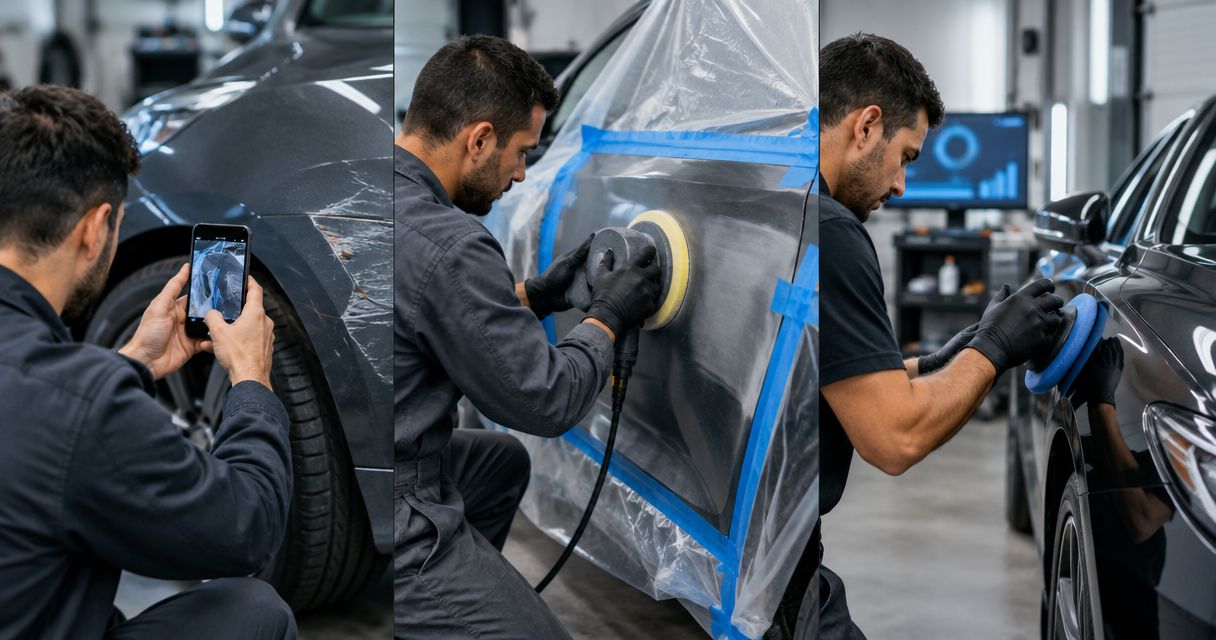
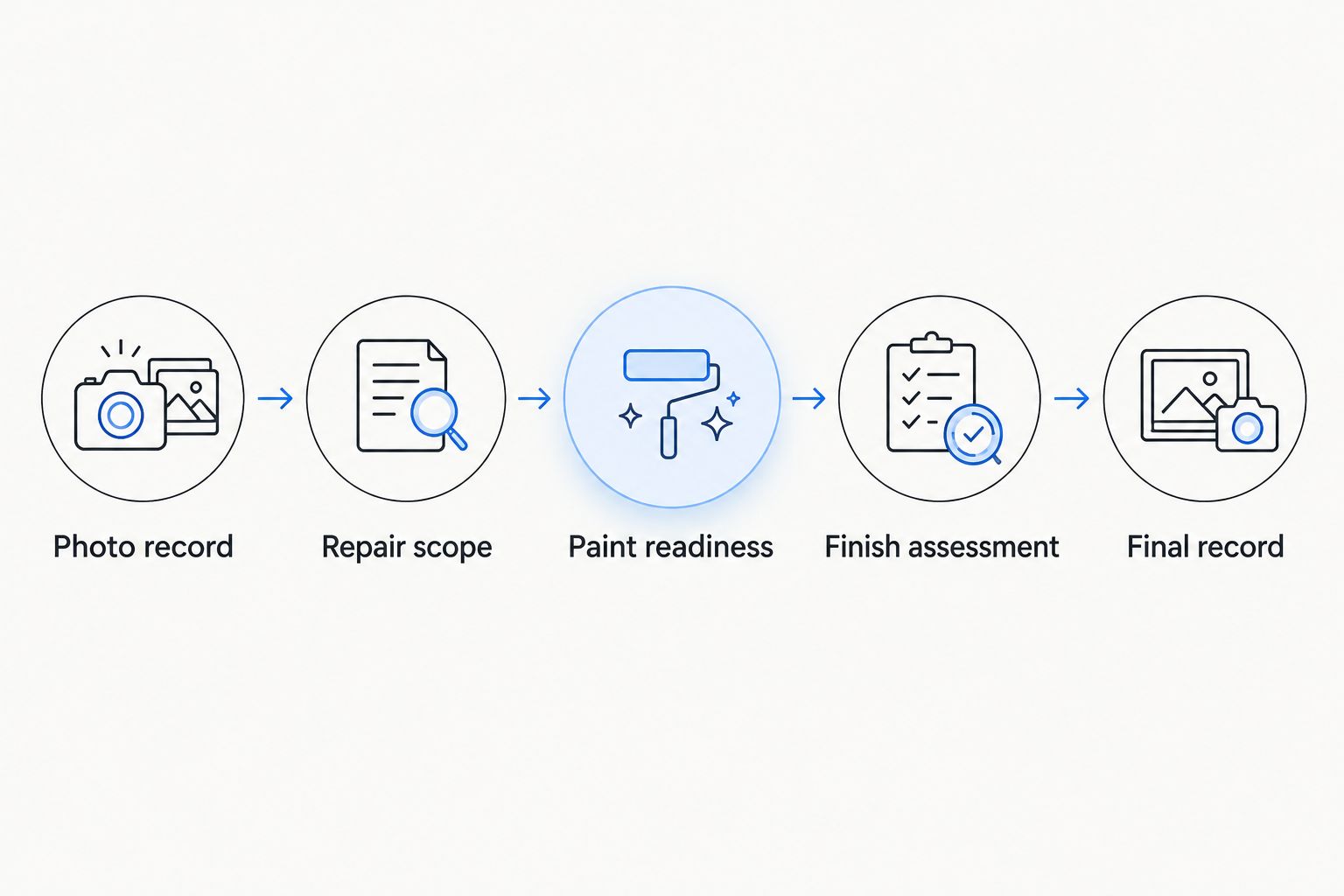
Instead of repeatedly sending damage photos and guessing when to book paint correction after insurance claim repairs, follow a documented handoff: photograph the damage, confirm the repair scope, obtain paint-care instructions, then arrange an inspection. Royal Touch Mobile Detailing LLC brings faith-driven service, a commitment to doing work right the first time, and experience with premium vehicles and aircraft to the detailing side of that process.
- For paint correction after insurance claim repairs, document damage before polishing and confirm the repair scope first.
- Royal Touch Mobile Detailing LLC offers paint correction; structural damage and failed paint need repair, not polishing.
- Freshly repainted panels need the refinisher’s care instructions before paint correction or ceramic coating.
- Keep original claim photos separate from repair-completion photos so each stage remains clear.
Why this matters
Repair first, refine the finish second. Paint correction uses polishing abrasives to reduce suitable surface defects. It does not straighten dented panels, replace missing paint, or repair peeling clear coat. Mixing those jobs can leave you booking the wrong service while the underlying damage still needs attention.
Royal Touch Mobile Detailing LLC is best for owners seeking mobile paint correction and vehicle protection, not collision repair. You can discuss your vehicle’s condition through Royal Touch Mobile Detailing LLC once you have the repair details ready.
For a claim handled in 2026, keep the insurer’s instructions, repair documents, and detailing scope together. A polished finish is not evidence that an accident repair is complete; the body shop’s repair work and the detailer’s cosmetic work need separate checks.
Before you start
- Gather claim access and repair records. Have your claim reference, insurer’s submission instructions, estimate, body shop contact, and any prior paint-protection records. Use the insurer’s own instructions for uploading files; portal labels differ.
- Prepare your photo materials. Use a camera or phone, keep unedited originals, and record the date and affected panel. Before cleaning or altering damaged areas, confirm whether the insurer or repairer still needs to inspect them.
- Get the repaint restrictions early. Ask the body shop which panels were refinished and when washing, polishing, and applying protection are permitted. Vehicle pickup is not automatic permission to polish or coat fresh paint.
Do not book correction against an assumed paint-curing deadline. The refinishing products and repair process determine the instructions. Get those instructions from the shop responsible for the repaint, preferably in writing.
Claim photo record
The first configuration unit is your evidence folder. For your 2026 claim record, organize images by condition and date rather than placing every photo into a single camera-roll export.
- Preserve the original condition. Photograph the damage before polishing, touching up paint, or applying products that change its appearance. Do not move an unsafe vehicle or enter traffic to get a better angle.
- Capture 3 views per affected panel. Take a wide view showing the location, a medium view showing the whole affected panel, and a close view showing the defect. This is a working checklist, not an insurer’s minimum requirement; follow any additional instructions you receive.
- Change the viewing angle. Photograph the same mark from an angle that reveals its edges and reflections. Avoid glare that hides scratches, and keep the original image alongside any annotated copy.
- Add a plain description. Record the panel name and what you can see: dent, scratch, paint transfer, crack, or exposed underlying material. Do not diagnose hidden damage from a photograph.
- Submit through the required channel. Follow the insurer’s directions and retain the submission confirmation. Keep any requests for additional photographs with the original record.
Expected result: You have a dated record showing where the damage is and what it looked like before cosmetic work. That record supports the handoff; it does not replace a repair inspection.
Repair scope and responsibility
Your next job is separating collision repair from finish improvement. Ask the body shop and insurer to clarify any uncertainty before you authorize separate detailing work.
- Read the repair scope by panel. Identify the areas scheduled for repair, replacement, or refinishing. Ask the shop to explain unfamiliar terms in everyday language.
- Separate existing marks from incident damage. Record older swirls, scratches, or previous repairs without presenting them as new damage. Keep the correction request specific to what you want inspected.
- Clarify payment responsibility. Ask whether a proposed cosmetic operation belongs in the approved repair scope or is separate owner-authorized work. Do not assume an insurance claim includes paint correction or replacement ceramic coating.
- Route unresolved repair defects back to the shop. Report paint peeling, exposed substrate, panel-fit concerns, or a suspected color mismatch before arranging polishing. A detailer should not be asked to conceal an unresolved repair concern.
- Write the handoff summary. List the affected panels, completed repairs, outstanding questions, and refinishing restrictions. Give the detailer the relevant summary rather than unrelated personal claim documents.
Expected result: You know which concerns belong with the repairer and which are appropriate for a detailing assessment. Approval for one job does not automatically authorize another.
Match the service to the defect
Choose the service by the condition of the panel, not by how dramatic a scratch looks in a photograph. These options have different jobs and different limits.
| Service | Best for | Benefit | Limit or trade-off |
|---|---|---|---|
| Body repair or refinishing | Dents, missing paint, failed coatings, and repair-related concerns | Addresses damage that polishing cannot repair | Requires repair-shop assessment; refinished paint has care restrictions |
| Paint correction | Suitable surface swirls, haze, and shallow finish defects | Refines the appearance of sound paint | Removes some paint material; deep defects can remain |
| Ceramic coating | Suitable, prepared paint when protection is the goal | Adds a protective surface treatment after preparation | Does not repair dents or deep scratches; needs ongoing care |
Do not select the most aggressive polishing process simply because the vehicle had an insurance claim. The finish condition, repair history, and inspection should determine the work.
Paint readiness and correction handoff
For a 2026 repair handoff, carry the body shop’s instructions into the detailing appointment. A calendar reminder without those instructions is not enough.
- Collect the completion documents. Ask which panels were painted, which adjacent areas were blended, and what restrictions apply. Keep the repair invoice and paint-care instructions together.
- Inspect before accepting cosmetic changes. Look at repaired panels in daylight and directional light. Photograph concerns and ask the body shop to assess them before another provider changes the finish.
- Confirm readiness for each operation. Ask specifically about washing, abrasive polishing, wax or sealant, and ceramic coating. Permission for gentle washing is not permission for every other process.
- Request a finish assessment. Explain your priorities: reducing visible swirls, improving haze, preserving paint, or preparing for protection. Share previous repaint information and identify any coating or film already on the vehicle.
- Ask for 1 representative test area. A controlled test helps the detailer judge whether an appropriate polishing approach improves the finish. Ask how paint condition and remaining material will be assessed before broader work begins.
- Agree on the stopping point. Confirm which defects will be addressed and which should remain rather than be chased with additional abrasion. Get that scope settled before authorizing work.
Expected result: The detailer has the repair history, relevant restrictions, and a defined cosmetic goal. You understand that responsible correction can leave some marks visible.
The sequence matters more than choosing a polishing stage in advance. Keep repair approval and finish assessment ahead of the correction decision.
Final record and aftercare
Close the workflow with documentation, not just a glance at a shiny panel. Keep the correction record distinct from the collision-repair record.
- Create 2 separate photo sets. Label one set as the original damage record and the other as the post-repair, post-detailing record. Retain earlier repair-completion photographs as their own dated stage when available.
- Repeat the useful angles. Photograph the same panels from comparable positions and lighting where practical. Avoid presenting differences caused only by lighting as proof of correction.
- Review the agreed scope. Check the areas selected for correction and discuss remaining defects. Ask whether any finding needs to return to the body shop rather than receive more polishing.
- Record protection separately. Note whether protection was applied and to which panels. If a previously coated panel was refinished, ask about that panel specifically rather than assuming its previous coating remains.
- Follow the applicable care instructions. Keep refinisher guidance and any protection-product aftercare together. If instructions conflict, resolve the conflict with the responsible providers before washing or applying another product.
Expected result: You have a clear before-and-after record, an agreed account of the work, and instructions for caring for the finish. Your 2026 maintenance notes should distinguish collision repairs from cosmetic correction.
When the repair scope changes
A repair can reveal additional damage or require another panel to be refinished. Update the handoff whenever the repair scope changes, rather than leaving the detailing appointment tied to the original estimate.
- Add the revised repair documents and new photographs to the record.
- Identify any newly refinished or blended panels.
- Request updated paint-care instructions for those areas.
- Tell the detailer what changed before confirming the correction scope.
- Reconfirm payment responsibility for any additional cosmetic work.
This variant also applies when the body shop reworks a finish concern after vehicle collection. Earlier permission to polish a panel does not replace instructions for its newly refinished surface. Keep untouched panels and reworked panels clearly identified.
Troubleshooting
The insurer asks for clearer photographs
Retake the requested views without deleting the originals. Use an angle that shows the panel location and the defect, and follow the insurer’s submission directions. Do not polish the mark to make it easier to photograph.
A scratch is still visible after repair
Ask the body shop whether the mark is within the completed repair area and whether it is a repair concern. If it is a suitable surface defect on sound paint, a detailer can assess correction; photographs alone cannot establish its depth.
The repainted panel looks different
Return a suspected color or finish mismatch to the body shop for assessment before polishing. Correction is not a substitute for evaluating whether the refinish work needs adjustment.
The detailer and body shop give different care instructions
Pause the disputed operation and ask both providers to clarify the specific panel, product, and restriction. Obtain a consistent plan before proceeding. Do not choose a deadline from a general online guide.
Correction reveals a deeper defect
Stop treating the defect as a polishing target and reassess the scope. Missing paint, cracking, or clear-coat failure needs a repair evaluation; further abrasion is not the answer.
Customize your workflow
For a daily driver, prioritize a sound finish and manageable maintenance rather than removal of every visible mark. For a luxury or performance vehicle, bring previous repair and protection records so the assessment accounts for the finish history.
Use the paint correction stages guide to understand the vocabulary, then choose the scope after inspection. A stage name describes a process, not a guaranteed result.
Royal Touch Mobile Detailing LLC offers paint correction and ceramic coating alongside mobile detailing. Discuss the repaired panels, your appearance goals, and the body shop’s restrictions before choosing services. Aircraft owners, flight schools, and charter operators should use an aircraft-specific care plan rather than transferring this automotive claim workflow unchanged.
Discuss your repaired vehicle
Share the repair history and paint-care instructions before arranging a detailing assessment.
FAQ
When should I book paint correction after insurance claim repairs?
Arrange paint correction after the repair scope is resolved and the refinisher has confirmed that the affected paint is ready for polishing. Share those instructions with the detailer before authorizing work.
Should I polish a scratch before sending insurance claim photos?
Document the original damage before polishing it. Confirm whether the insurer or repairer needs further inspection before you alter the affected area.
Does insurance cover paint correction after an accident?
Coverage depends on the policy, incident, and approved repair scope. Ask the insurer whether the proposed work is included before authorizing separate detailing.
Can paint correction fix a deep accident scratch?
Paint correction cannot replace missing paint or repair structural damage. A suitable shallow surface defect can be assessed for polishing, but deeper damage needs repair evaluation.
Can I ceramic coat a freshly repainted panel?
Apply ceramic coating only after the refinisher confirms that the panel is ready for that treatment. Follow the instructions for the actual repair rather than a universal waiting period.
What should I send a detailer after body shop repairs?
Send the relevant panel list, repair history, paint-care instructions, and photographs of the concerns you want assessed. Keep unrelated personal and financial claim information out of the detailing handoff.
Is paint correction better than repainting?
Paint correction and repainting solve different problems. Correction refines suitable existing paint; refinishing addresses damage or finish failure that polishing cannot repair.
One last thing
A remaining scratch can be the responsible stopping point. Polishing removes material, so chasing a deep defect can work against preserving the finish. Ask what should remain untouched as well as what can improve; that conversation keeps appearance goals grounded in the condition of your paint.