
Instead of repeatedly cleaning your car without knowing what the return inspector will assess, use this workflow for detailing before lease turn in inspection: check your lease rules, clean, separate damage from dirt, and document the handoff. Royal Touch Mobile Detailing LLC brings faith-driven service, a commitment to doing work right the first time, and experience with premium vehicles and aircraft to mobile detailing—not a promise of zero lease fees.
- Royal Touch Mobile Detailing LLC suits drivers seeking mobile detailing before lease turn in inspection, not lease-charge guarantees.
- Use your lessor’s written wear standards to separate cleaning needs, paint correction, and repairs.
- Clean before assessing surface marks; detailing does not repair dents, torn upholstery, or damaged tires.
- Keep condition photos and return paperwork; a clean vehicle does not prove that every lease obligation is satisfied.
Why this matters
Detailing prepares a vehicle for assessment; your lease agreement determines your return obligations. Treat zero fees as a goal, not an outcome a detailer can promise. Mileage, missing equipment, damage, and other contract terms belong in a separate review from vehicle cleanliness.
For a 2026 lease return, start with the current instructions from your lessor rather than an old checklist or another driver’s experience. A clean cabin and exterior help you see what needs attention. They do not change the agreement.
Royal Touch Mobile Detailing LLC is best for lease-return drivers who want mobile detailing with cleaning and paint-care needs assessed separately from repairs. Review Royal Touch Mobile Detailing LLC when planning the detailing portion, and keep lease questions with your lessor.
Before you start
- Gather the rules and access details. Have your lease agreement, current return instructions, written wear standards, inspection arrangements, and access to the vehicle. Confirm where the return happens and who handles the inspection.
- Prepare the vehicle and work area. Remove personal belongings, identify equipment supplied with the vehicle, and discuss location access and working conditions with your detailer. Do not assume a parking garage or workplace permits on-site work.
- Check the inspection sequence first. Ask whether your lessor offers or requires an inspection before return. The non-obvious trap is authorizing cosmetic work before learning how an existing mark will be classified—or waiting until handoff to discover a repair issue.
Create 3 folders for your 2026 return: lease instructions, condition records, and handoff paperwork. These are an organizing recommendation, not a lessor requirement. Keep written answers beside the documents they explain.
Lease requirements and inspection plan
Establish the return rules
- Read your agreement and current return instructions. Identify the return deadline, mileage allowance, required equipment, and the process for assessing wear.
- Request the written wear standards that apply to your vehicle. Ask how scratches, dents, glass damage, upholstery damage, tires, and modifications are assessed; do not substitute generic online thresholds.
- Confirm the inspection arrangement. Ask who schedules it, where it happens, whether you can attend, and how you receive the findings.
- Record unresolved questions. If your vehicle has aftermarket tint or another modification, ask whether it must be removed or otherwise addressed before return.
- Confirm the handoff documents and equipment. Build your checklist from the lessor’s instructions, including keys and any originally supplied items specified there.
Expected result: You have a written return plan with the deadline, inspection process, applicable standards, and equipment checklist. You also know which questions still need an answer before authorizing work.
Avoid treating a dealership conversation as a substitute for the contract. If someone gives you instructions that differ from the written return guidance, ask for clarification in writing. That keeps the decision tied to your actual lease.
Separate your responsibilities
Use separate checklist headings for cleanliness, physical condition, and contract obligations. A stain belongs under cleanliness until assessment shows material damage; a missing key belongs under equipment. Mileage belongs under the agreement, not the detailing appointment.
For your 2026 plan, assign each unresolved item to the right person: the detailer for cleaning, an appropriate repair professional for damage, and the lessor for return requirements. Do not ask detailing to solve a contractual issue.
Cleaning scope and condition assessment
Build the detailing brief
- Remove belongings from the cabin, trunk, storage compartments, and seat pockets. Keep required vehicle equipment together instead of mixing it with items you are taking home.
- Photograph the vehicle before work. Capture visible stains, surface marks, damage, and any areas you want assessed.
- Describe each cleaning concern plainly. Note spilled drinks, pet hair, lingering odors, dirty mats, or exterior buildup without guessing how they must be treated.
- Request 1 written scope separating cleaning from any proposed paint correction. Ask what is included, what needs assessment, and what falls outside detailing.
- Confirm access and handoff arrangements with the detailer. Explain your inspection deadline without assuming a particular completion time.
Expected result: Your detailer receives a usable brief, and you have a written boundary between cleaning, surface correction, and repairs.
Mobile detailing brings the cleaning service to the vehicle, subject to the provider’s arrangements and site permissions. Its advantage is convenience; its limitation is that an unsuitable work location still needs another plan. Confirm the setting before the appointment, especially at shared residential or workplace parking areas.
Assess the clean vehicle
- Have the exterior and interior cleaned using methods appropriate to their materials. Tell the detailer about existing coatings, repaired surfaces, or sensitive trim when you know about them.
- Examine the cleaned panels in good light. Identify marks that remain instead of treating every dirty-looking area as damaged paint.
- Ask whether a remaining mark is surface contamination, a correctable finish defect, or damage requiring another professional. Do not authorize aggressive polishing simply because a mark is visible.
- Recheck upholstery, mats, glass, and storage areas. Note any stain or odor that remains and discuss the next appropriate treatment.
- Compare unresolved findings with the lessor’s written standards. If classification is unclear, ask the lessor or inspector rather than assuming the vehicle will pass.
Expected result: You have a clean vehicle and a remaining-issues list based on visible condition—not guesswork through road film or clutter.
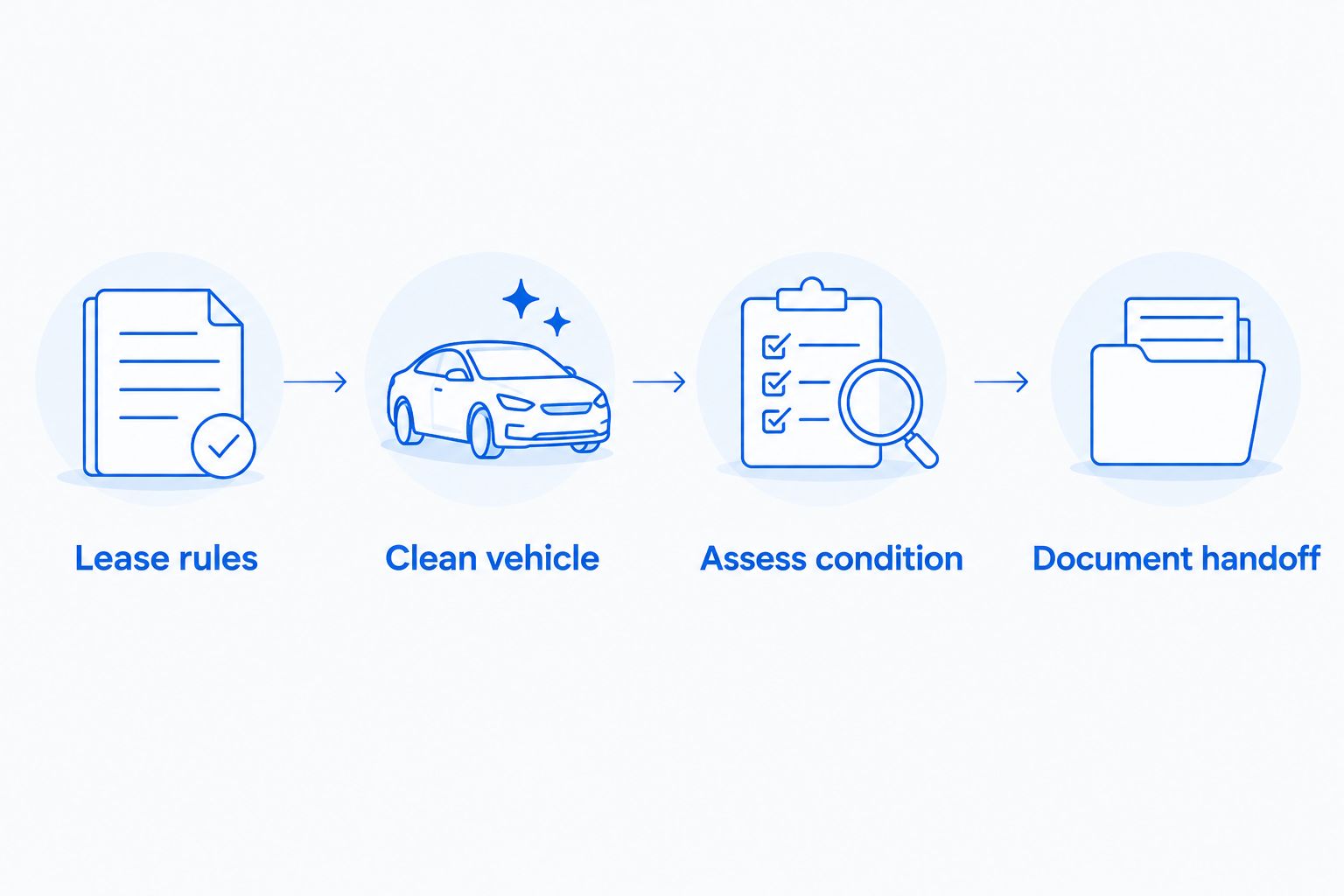
The core sequence is Lease rules, Clean vehicle, Assess condition, and Document handoff. Cleaning comes before the final cosmetic assessment because you need to see the actual surface.
Service decisions and handoff records
Match the work to the problem
Choose the service that addresses the condition, not the service with the most impressive description. A vehicle approaching return needs a clear reason for each additional treatment. Appearance, protection, and return compliance are different goals.
| Option | Best for | Advantage | Limitation |
|---|---|---|---|
| Interior and exterior detailing | Dirt, debris, and cleaning-related presentation issues | Cleans surfaces so remaining issues are easier to assess | Does not repair physical damage or settle lease obligations |
| Paint correction | Suitable surface-level paint defects after assessment | Addresses correctable finish defects | Not every scratch is safely correctable; it is not body repair |
| Repair assessment | Dents, cracked glass, torn material, or other damage | Directs the issue to the appropriate repair professional | Cleaning cannot replace the required repair work |
| Ceramic coating | Owners keeping a vehicle who want a protective paint treatment | Serves a paint-protection goal | Does not repair existing damage or establish return compliance |
- Put each remaining issue into cleaning, correction, repair assessment, or lease clarification. Leave uncertain items unresolved until the right professional reviews them.
- Ask the detailer to explain proposed correction in plain language. The paint correction stages guide provides background for that discussion, not a reason to choose the most involved process.
- Request the lessor’s instructions before arranging damage-related work. Confirm what documentation it expects if a repair is completed.
- Avoid adding a coating solely to pursue zero fees. Ask which specific problem the proposed work addresses and whether that problem affects your return.
Expected result: Every authorized task has a defined purpose, and physical damage stays separate from cosmetic cleaning.
Royal Touch Mobile Detailing LLC offers mobile detailing, paint correction, ceramic coating, and window tint services. For lease-return preparation, the useful starting point is an assessment and cleaning scope—not automatically combining every available service.
Document the handoff
- Take 2 photo sets: one before detailing and one near the return handoff. This is a recordkeeping recommendation, not a universal inspection rule.
- Include broad views and close-ups. Photograph the cabin, exterior, visible existing damage, odometer reading, and equipment being returned.
- Keep service records beside the condition photos. Where repairs were completed, retain the paperwork requested by the lessor.
- Obtain the available inspection and return documents. Read them before filing them, and ask how any unresolved findings will be communicated.
- Keep copies of correspondence about disputed condition items. Photographs support a record; they do not replace the lessor’s inspection or guarantee a particular decision.
Expected result: Your 2026 return folder contains the condition record, completed-work documents, and available handoff confirmation. You can distinguish what was cleaned, what was repaired, and what remained unresolved.
When the inspection report arrives before detailing
An inspection-first workflow is useful when your lessor makes a preliminary report available. Use the report to target the work, rather than treating every cosmetic imperfection as a project.
- Read the report and separate listed cleaning concerns from damage, equipment, and contract issues.
- Ask how completed work is reviewed and whether another assessment is required. Confirm the applicable deadline directly with the lessor.
- Give the detailer the relevant cleaning findings and your own observations. Ask for an assessment rather than a promise that the report will be cleared.
- Send damage-related items to the appropriate repair professional. Keep the cleaning appointment focused on cleaning and suitable surface work.
- Document the completed work and follow the lessor’s submission or review instructions.
The advantage is a more focused brief. The limitation is that a preliminary report does not replace your agreement or establish that cleaning alone resolves every finding. Follow the review process supplied for your vehicle.
Troubleshooting
A scratch remains after washing
Stop treating the scratch as dirt. Ask for a paint assessment, then compare the finding with your lessor’s standards. Polishing is not the answer to every visible scratch, and body damage belongs with a repair professional.
A stain or odor survives the first treatment
Describe its source if you know it, and ask whether another material-appropriate treatment is suitable. Do not add fragrance to hide the issue or assume repeated shampooing is always appropriate. The aim is to address the contamination without damaging the material.
The mobile work location is unsuitable
Contact the provider before the appointment and explain the access restriction or site condition. Arrange a permitted, suitable location through that discussion. Do not assume your building allows detailing because it allows parking.
The inspector identifies a problem after detailing
Read the finding and identify whether it concerns cleanliness, damage, missing equipment, or the agreement. Submit relevant records through the lessor’s stated process. A detailing invoice shows service work; it does not prove that a listed damage item was repaired.
Customize your workflow
For a luxury or performance vehicle, discuss finish care and interior materials before authorizing correction or stain treatment. Explain any known repaired panels, coatings, or sensitive surfaces. Doing the work right starts with choosing appropriate work, not adding unnecessary services.
If your 2026 plans change and you keep the vehicle, reassess the goal. Long-term protection becomes a separate conversation from return preparation; a coating should be discussed for that purpose, not as an inspection shortcut.
For a trade-in instead of a lease return, change the paperwork and decision criteria to match an appraisal. Keep the clean-assess-document sequence, but do not carry lease-specific requirements into a different transaction.
Plan your lease-return detailing
Discuss cleaning concerns, paint assessment, and mobile detailing arrangements before your inspection.
FAQ
Should I get detailing before lease turn in inspection?
Use detailing before lease turn in inspection when the vehicle needs cleaning or clearer condition assessment. Check your lessor’s inspection sequence first, and keep cleaning separate from repairs and contractual obligations.
Can detailing guarantee zero fees at lease return?
No, detailing cannot guarantee zero lease-return fees. Your agreement, vehicle condition, mileage, required equipment, and the lessor’s assessment remain separate from the cleaning service.
Should I book an inspection or detailing first?
Confirm your lessor’s inspection process before booking detailing. If a preliminary report is available, use it to focus the work; otherwise, clean the vehicle before your final cosmetic assessment.
Will paint correction remove every scratch before lease return?
No, paint correction does not remove every scratch or replace body repair. Have remaining marks assessed and compare the findings with your lessor’s written wear standards.
Is ceramic coating necessary before returning a leased car?
Do not treat ceramic coating as a lease-return requirement unless your actual instructions establish that requirement. It is a protective treatment, not a repair or proof that the vehicle meets return standards.
What should I remove before a lease-return detail?
Remove personal belongings and separate them from equipment that must stay with the vehicle. Use your lessor’s instructions to identify the items required at handoff.
What records should I keep after detailing?
Keep condition photos, the agreed service scope, completed-work records, and available inspection and return paperwork. These document the process but do not guarantee how the lessor will classify a condition item.
One last thing
Do not lose required vehicle equipment while clearing out personal belongings. Keep the lessor’s equipment checklist beside the vehicle as you empty it, and check it again at handoff. Cleaning and organizing should not create a new return problem.
The strongest 2026 workflow ends with a documented handoff—not merely a freshly cleaned car. Know the rules, choose appropriate work, and keep the records together.