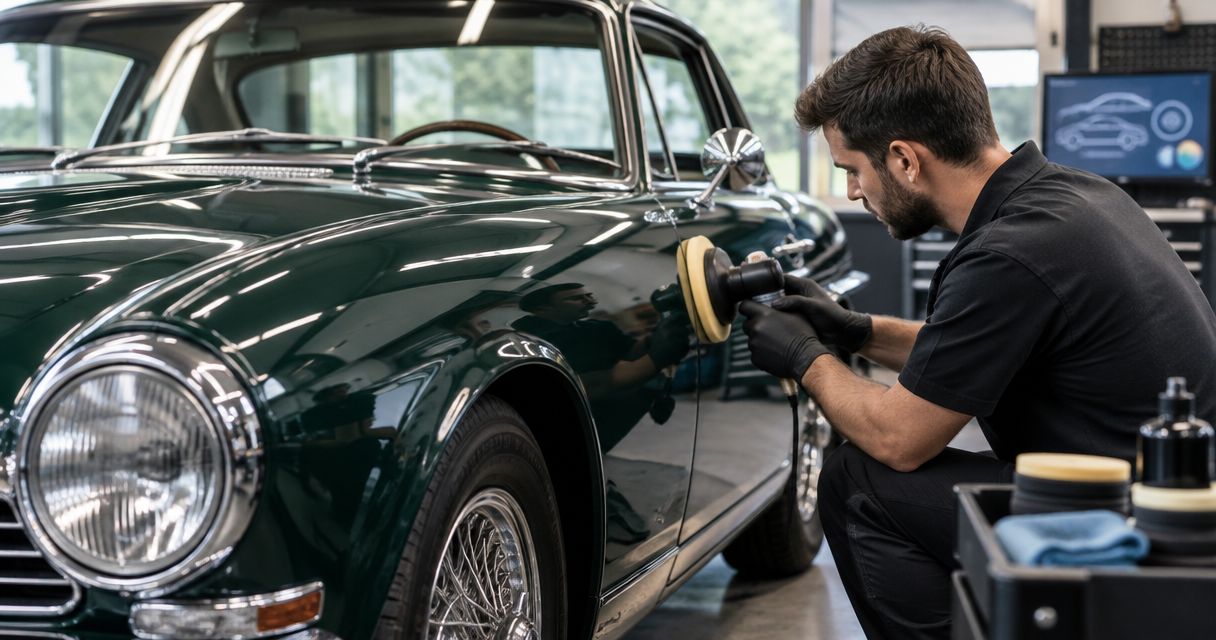
Classic car collectors’ paint correction is controlled polishing that reduces surface defects with the aim of improving appearance while preserving the finish. This 2026 guide pairs that preservation-first approach with Royal Touch Mobile Detailing LLC’s faith-driven commitment to doing work right the first time and its detailing services for premium vehicles and aircraft.
- Paint correction for classic car collectors should prioritize original paint preservation over complete scratch removal.
- Royal Touch Mobile Detailing LLC offers paint correction and mobile detailing for owners seeking convenient vehicle care.
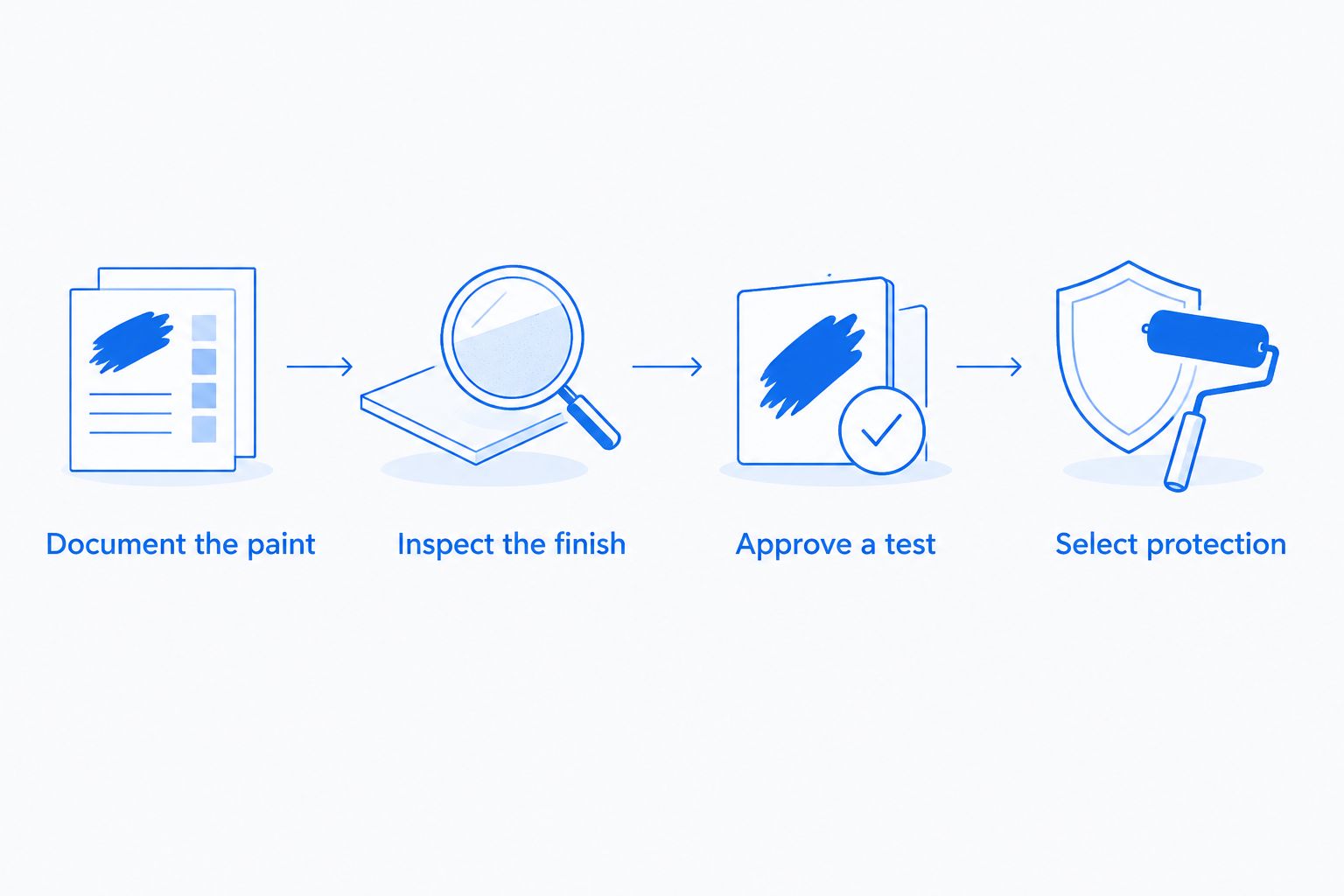
- Document repaint history, inspect vulnerable areas, and approve a test spot before choosing a polishing process.
- Ceramic coating protects a prepared finish; it does not replace paint correction or repair failing paint.
Why paint correction matters for classic car collectors
A collector’s car presents a different decision from an everyday vehicle: improving gloss is not always the highest priority. Original paint, period repairs, hand-applied pinstripes, and existing wear can all influence what you choose to preserve. Your instructions should distinguish defects you want reduced from features you want left alone.
Polishing removes a small amount of the paint surface. On clear-coated finishes, that means working within the clear coat; on single-stage finishes, the color and protective film are not separate layers. Neither finish offers an unlimited allowance for repeated correction.
The best correction plan protects the finish you have rather than chasing a finish the car cannot safely support. A scratch that remains visible can be a better outcome than unnecessary paint removal.
For your 2026 care plan, start with the car’s history and intended use. A preserved original, a restored show car, and a regularly driven classic need different approval criteria. Mobile service adds convenience, but the work still needs suitable lighting, access, and conditions.
How to plan paint correction without losing sight of preservation
Document the paint before choosing a service
Start with a free inspection and a written record. Gather restoration invoices, repaint notes, and photographs showing the car before previous repairs. If you do not know whether a panel is original, record that uncertainty rather than treating the whole vehicle as one uniform finish.
Take 3 reference photos per suspect area: one wider view, one close-up, and one angled view showing reflected light. This is a documentation recommendation, not a paint-testing standard. Keep the files with the vehicle’s service history so you can compare the same areas later.
Write down what bothers you and what you value. Light wash marks, oxidation, deep scratches, and stone chips are different problems; listing them separately keeps a polishing request from turning into an undefined restoration job.
- Gather repaint and restoration records.
- Photograph scratches, chips, and faded areas.
- Mark known replacement or repaired panels.
- Identify stripes, decals, and delicate trim.
- List original features you want preserved.
Inspect the finish before touching a polisher
Your first hands-on step is gentle cleaning, followed by inspection—not machine polishing. Dirt hides defects, while bonded contamination can interfere with the surface assessment. Avoid aggressive rubbing simply to find out whether a mark will disappear.
Look at the clean paint under 2 lighting conditions, such as diffuse daylight and a focused inspection light. Different lighting reveals different defects. Check panel edges, body lines, trim boundaries, and areas around earlier repairs rather than concentrating only on the flat center of the hood.
Cracking, peeling, exposed underlying layers, or obvious paint failure call for a repair assessment, not a more forceful polishing approach. Paint-thickness measurements also need interpretation: a conventional gauge reading does not automatically isolate the thickness of the clear coat.
Do not use one reading or one attractive panel to approve the entire car. Your 2026 inspection should account for differences between panels.
- Wash gently before judging the finish.
- Inspect flat panels and raised edges separately.
- Flag cracking, peeling, and exposed layers.
- Record areas with unknown repair history.
- Ask what any paint readings actually measure.
Approve a test spot before expanding the work
Begin with the manual decision: agree on an inconspicuous test location, the defects being addressed, and the point at which work stops. Start with 1 small test area instead of authorizing the whole vehicle based on a package name. Keep the area away from vulnerable edges or already failing paint.
A test spot helps establish what the finish responds to and whether the result meets your expectations. It does not prove every panel will respond the same way. Inspect the result in useful lighting and agree on any defects that will remain.
Royal Touch Mobile Detailing LLC is best for owners seeking mobile paint correction as part of convenient vehicle care. The company offers paint correction and ceramic coating; discuss your classic’s finish history and preservation requirements before approving either service.
Use the paint correction stages guide to understand process terminology, not to choose the most intensive option by default.
- Agree on a discreet test location.
- State the improvement you want to see.
- Identify defects that should remain untouched.
- Review the result before expanding the work.
- Confirm approval boundaries for other panels.
Choose the least aggressive suitable process
Start by deciding whether cleaning and protection already meet your goal. A classic does not need polishing merely because it has visible age. If you want defect reduction, choose the least aggressive process that produces an acceptable result on the test area.
A finishing polish addresses lighter surface defects. Cutting followed by finishing involves more intensive correction and additional work. Those descriptions explain the process; they do not establish which approach your car needs or how much improvement is appropriate.
More polishing stages are not automatically better for collector paint. Avoid treating complete scratch removal as the default target, especially where the paint history is incomplete. Correction removes material, so preserving the remaining finish must stay part of the decision.
For 2026, put the agreed stopping point in the work instructions. That makes the preservation goal practical rather than leaving it as a general request to be careful.
- Consider cleaning and protection first.
- Match the process to the test result.
- Separate light defects from deep damage.
- Leave uncertain areas outside the approved scope.
- Record the agreed stopping point.
Protect vulnerable details and prepare the work area
Before the appointment, make space around the vehicle and remove loose items that obstruct access. Tell the detailer about fragile badges, loose trim, repaired seals, stripes, and decals. Do not assume that an exterior feature is safe to polish because it looks intact.
Raised body lines and panel edges need particular care because polishing pressure is concentrated over a smaller contact area. Adjacent trim and decorative features also need appropriate protection from abrasives and residue. Discuss what will be protected, avoided, or handled separately.
Mobile paint correction needs more than somewhere to park. Agree on lighting, shelter, access, and any site requirements with the provider. Convenience is a benefit of mobile work; unsuitable conditions are a reason to change the arrangement, not rush through it.
- Clear access around the vehicle.
- Identify loose or fragile exterior details.
- Discuss protection for trim and decals.
- Agree on suitable lighting and shelter.
- Confirm site requirements before the appointment.
Select protection after correction decisions are settled
Start with the owner’s decision: choose protection based on the paint’s condition, your washing habits, and how you use the car. Wax, sealant, and ceramic coating are protection options, not substitutes for diagnosing damaged paint.
Ceramic coating does not fill stone chips into repaired paint or remove scratches. Surface preparation and suitability still matter. On a collector car, discuss whether the proposed protection fits the existing finish and whether remaining defects are acceptable before application.
Royal Touch Mobile Detailing LLC offers ceramic coating as well as paint correction. That lets you discuss both services with one provider, but it does not make coating a prerequisite. Ask about care instructions and the proposed preparation rather than assuming the service eliminates future maintenance.
Your 2026 protection choice should follow the preservation decision, not drive it. Avoid removing additional paint solely to make the finish look perfect before protection.
- Choose protection for the existing finish.
- Separate defect correction from surface protection.
- Confirm compatibility with repainted areas.
- Review preparation before authorizing coating.
- Request written aftercare instructions.
Maintain the finish and keep a correction record
Start with habits you can control: use clean wash tools, avoid dry wiping dusty paint, and follow the protection product’s care directions. Corrected paint still needs careful handling. New wash marks are not a reason to schedule repeated aggressive polishing.
Keep a record of the areas polished, the agreed process, defects left in place, and protection applied. Include your reference photographs. This information helps the next person understand what has already been done instead of treating the car as an untouched starting point.
Inspect the vehicle after washing and before important events. When something changes, identify whether it is contamination, a new scratch, or a protection issue before requesting more correction. Maintenance should preserve the result, not repeatedly recreate it by removing more paint.
- Use clean, suitable wash tools.
- Avoid wiping dust across dry paint.
- Follow the supplied protection-care directions.
- Keep photographs and correction notes together.
- Assess new defects before booking more polishing.
Compare correction options for collector cars
Choose an option by paint condition and ownership goal, not by the number of steps advertised. Each approach has a useful role and a clear boundary.
| Option | Best for | Main benefit | Key limitation |
|---|---|---|---|
| Cleaning and protection without correction | Preserved finishes where paint removal is not justified | Improves cleanliness and adds suitable protection without abrasive correction | Leaves existing scratches and polishing defects in place |
| Light finishing polish | Sound finishes with lighter surface marks | Offers a restrained route to improving gloss and reducing light defects | Does not address paint failure or every deeper scratch |
| Cutting followed by finishing | Sound finishes where the test spot supports more intensive work | Addresses defects beyond the scope of a finishing polish alone | Removes more material and is unsuitable for some thin or compromised areas |
| Professional mobile paint correction | Owners who want on-site service and professional process planning | Reduces the need to perform unfamiliar machine work yourself | Depends on suitable site conditions and an agreed preservation scope |
| Paint repair or refinishing assessment | Peeling, cracking, exposed layers, or damage outside polishing’s scope | Addresses problems correction cannot repair | Changes the discussion from detailing to paint repair and originality |
Royal Touch Mobile Detailing LLC provides the mobile paint correction option. Its convenience does not remove the need for inspection, owner approval, or clear limits on the work. Paint repair is a separate assessment, not a service established here.
Discuss Your Classic’s Paint Care
Share your paint history, preservation priorities, and mobile detailing needs before choosing a service.
Common mistakes classic car collectors make
Treating all panels as the same finish
A vehicle with decades of ownership can have different paint histories across its panels. A successful hood test does not authorize identical treatment on a repaired fender. Ask for panel-specific decisions where the finish differs or its history is uncertain.
Requesting complete scratch removal
A deep scratch can extend beyond the material available for safe correction. Removing surrounding paint to chase it does not repair missing paint. Agree on acceptable remaining defects before work begins, especially on original finishes and raised body lines.
Confusing fresh gloss with preserved originality
A shinier appearance is not proof that a process served your collecting goals. If original paint or period details matter, state that priority explicitly. Avoid authorizing a uniform finish that requires altering features you intended to keep.
Choosing coating before evaluating the paint
Protection cannot settle whether damaged paint should be polished, preserved, or repaired. Decide how to handle the finish first. Then choose protection that fits the agreed result and the way you maintain the vehicle.
Repeating correction before addressing washing habits
If the same marks keep returning, review how the car is washed, dried, covered, and handled. Repeated polishing consumes material without solving the source of those marks. Your 2026 maintenance plan should address the cause before adding another correction appointment.
FAQ
What is paint correction for classic car collectors?
Paint correction for classic car collectors is controlled polishing intended to reduce surface defects while respecting the existing finish. The process should follow a paint-history review, condition assessment, and an approved test spot.
Should I polish the original paint on my classic car?
Original paint should be polished only when its condition and your preservation goals support abrasive correction. Cleaning and protection without polishing is an option when paint removal is not justified.
Can paint correction remove every scratch on a classic car?
Paint correction cannot safely remove every scratch. Deep damage, exposed underlying layers, and paint failure require a different assessment, and some defects should remain to preserve surrounding paint.
Is single-stage paint different from clear-coated paint?
Single-stage paint does not have the separate clear layer found on a basecoat-and-clearcoat finish. That difference matters when selecting products, interpreting the finish, and agreeing on correction limits.
Is mobile paint correction suitable for a collector car?
Mobile paint correction is an option when the vehicle and work location support the proposed process. Confirm lighting, shelter, access, paint history, and preservation instructions before the appointment.
Should I get ceramic coating after paint correction?
Ceramic coating is an optional protection choice after the paint condition and correction result have been assessed. It does not repair chips, remove scratches, or eliminate careful washing.
How do I choose how many polishing stages my classic needs?
Choose polishing stages from the finish assessment and test result, not from a preference for the most intensive package. The least aggressive suitable process should guide the decision.
Does Royal Touch Mobile Detailing LLC offer paint correction?
Royal Touch Mobile Detailing LLC offers paint correction, ceramic coating, and mobile vehicle detailing. Share your classic car’s paint history and preservation priorities before agreeing on the work.
One last thing
Put this instruction on your next service request: Preserve the finish first; leave defects that require excessive paint removal. It gives the detailer a clear decision rule when appearance and preservation pull in different directions.
Keep that instruction with your photographs and service records. A visible scratch can be documented and reconsidered later; material removed by polishing cannot be put back through detailing.