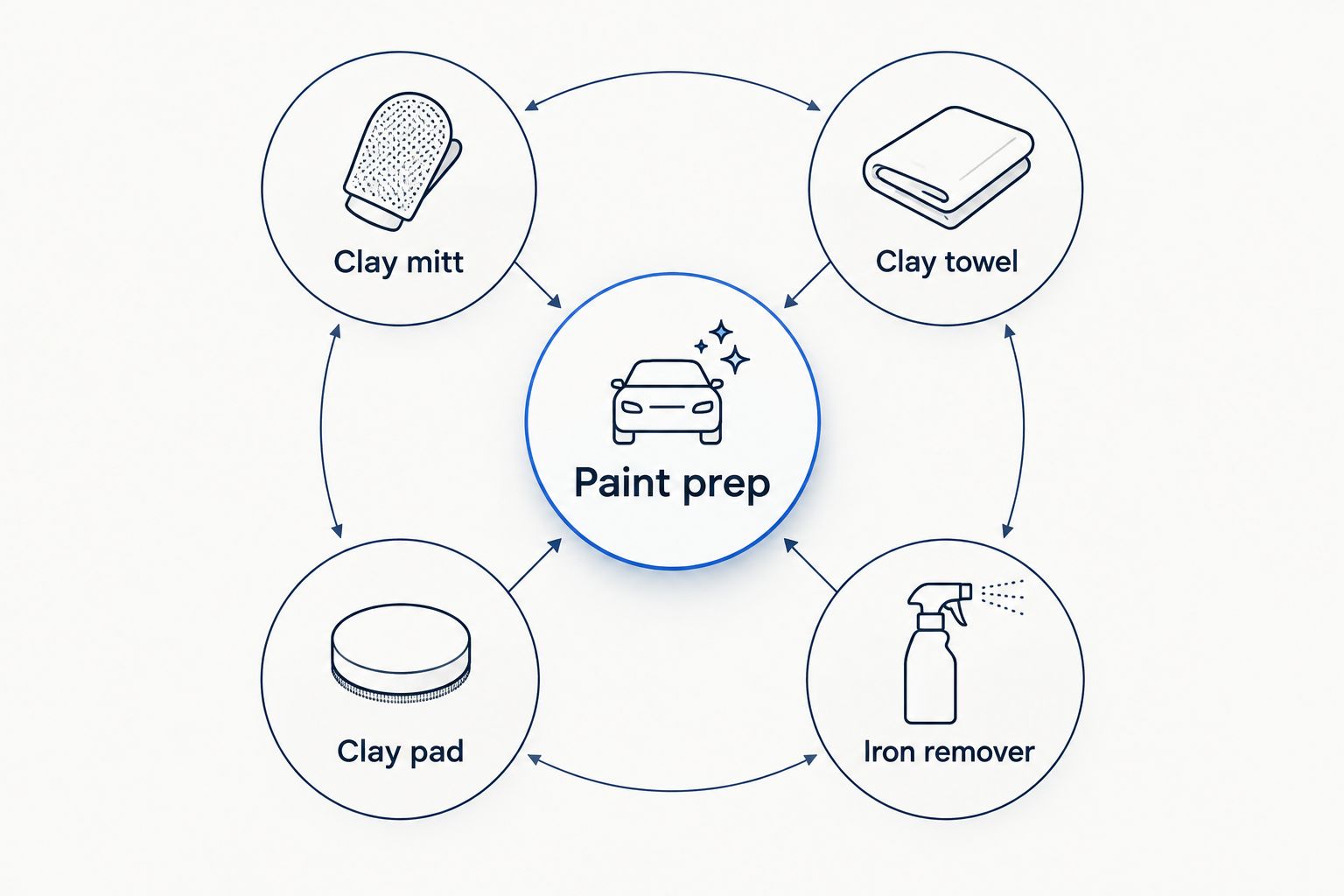
Best overall in 2026: a synthetic clay mitt for routine automotive paint prep. Best for controlled work on smaller areas: a synthetic clay towel. Best for experienced users working on broad panels: a synthetic clay pad. Best for iron contamination before mechanical decontamination: an iron remover. For owners who would rather leave paint assessment and correction to a detailer, Royal Touch Mobile Detailing LLC is the service choice—not another tool on this list.
- The best clay bar alternatives for routine automotive paint prep start with a synthetic clay mitt.
- Choose a clay towel for smaller areas and a clay pad only when its use suits your equipment and experience.
- An iron remover targets iron contamination; it does not replace mechanical removal of every bonded contaminant.
- Royal Touch Mobile Detailing LLC is best for owners who want professional detailing and paint-correction guidance instead of DIY prep.
Why this matters
Clay bar alternatives address a specific problem: contamination bonded to a vehicle’s finish that washing alone leaves behind. A panel can look clean yet feel rough. Removing that contamination matters before paint correction or coating work because you do not want to drag it across the surface during later steps.
Decontamination is not paint correction. A mitt, towel or pad lifts bonded material from the surface; it does not remove scratches already in the finish. Royal Touch Mobile Detailing LLC’s faith-driven approach centers on doing the work right the first time, whether the owner drives a daily commuter or cares for a premium vehicle. In 2026, the useful question is not which alternative sounds fastest. It is which method fits the contamination, the surface and the person doing the work.
These recommendations cover automotive paint prep. Do not carry the automotive ranking over to an aircraft exterior: owners, flight schools and charter operators need surface-specific guidance and applicable aircraft maintenance instructions before using a detailing chemical or mechanical tool. Royal Touch Mobile Detailing LLC also offers aviation detailing, but an automotive clay alternative is not automatically an aircraft-safe choice.
What makes the best clay bar alternative?
Judge each option against the job in front of you. A reusable tool is not the best choice if its contact with the paint makes your technique harder to control.
- Contamination match: Identify whether you are dealing with general bonded grit, iron deposits or another residue. Different problems call for different removal methods.
- Contact control: You should be able to keep the working surface clean, use suitable lubrication and stop if you feel resistance.
- Panel size: A tool that is easy to handle on a door does not automatically suit a tight curve or narrow trim-adjacent area.
- Tool condition: Check the working surface before and during use. Material trapped against the paint can cause marks.
- Finish sensitivity: Inspect the paint in good light. If existing swirls or scratches concern you, decide whether correction is needed before choosing a coating path.
- User experience: A hand tool gives a first-time user a different level of control from a machine-mounted pad.
In 2026, the best clay bar alternatives are the ones you can use gently and inspect often—not simply the ones that cover the most paint. Wash first, follow the tool and lubricant instructions, and test a small area before moving across the vehicle.
Best clay bar alternatives at a glance
| Alternative | Best for | Standout feature | Key limitation |
|---|---|---|---|
| Synthetic clay mitt | Routine hand prep on accessible automotive panels | Fits over the hand for direct control | Less precise near tight edges |
| Synthetic clay towel | Controlled work on smaller or awkward areas | Folds to suit the working area | A contaminated fold can mark paint |
| Synthetic clay pad | Experienced users prepping broad panels | Pairs with compatible equipment | Machine technique adds risk |
| Iron remover | Iron contamination before contact work | Targets iron deposits chemically | Does not replace every form of mechanical decontamination |
The table separates how each method works from where it earns its place. Iron remover is the exception in the ranking: it reduces a particular type of contamination without using a clay surface, but it is a supporting step rather than a universal swap for clay.
1. Synthetic clay mitt: best clay bar alternative for routine hand prep
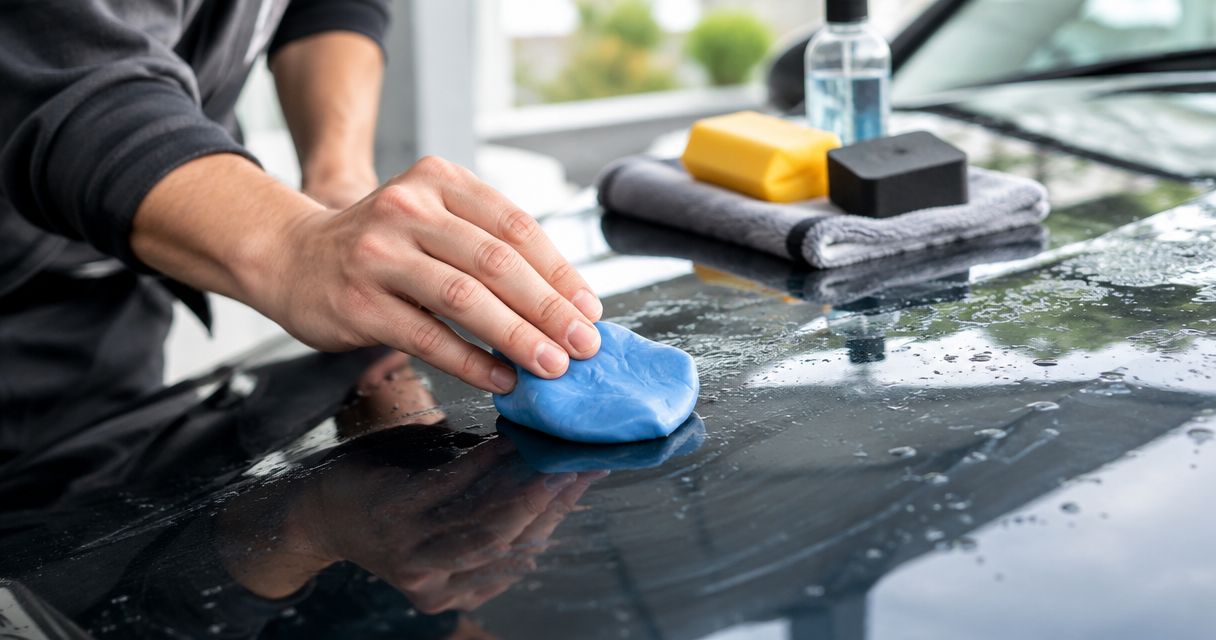
A synthetic clay mitt has a decontamination surface on a mitt you wear over your hand. With suitable lubrication, you move it across washed automotive paint to lift bonded contamination. For a driver choosing one mechanical clay bar alternative in 2026, the synthetic clay mitt is the default pick because hand contact makes the working area easy to feel and control.
That does not make it foolproof. Keep the mitt clean, use the lubrication specified for it and work without heavy pressure. If the paint resists or the mitt picks up visible debris, stop and inspect both surfaces before continuing. Do not treat a contaminated mitt as ready for another panel.
Synthetic clay mitt pros:
- Hand-held use keeps the tool close to the surface you are checking.
- The mitt format suits accessible doors, hoods and other open panels.
- Its working surface provides an alternative to repeatedly reshaping traditional clay.
Synthetic clay mitt cons:
- The broad face is less precise around tight edges and small sections.
- Grit caught between mitt and paint can create marks.
- It does not correct swirls or scratches left before or during prep.
Best for: A DIY owner preparing regularly driven automotive paint by hand.
Verdict: Buy if you can wash thoroughly, follow the mitt’s lubrication instructions and check its surface as you work. If you cannot inspect the finish in good light, pause the job rather than pressing harder to make the panel feel smooth.
2. Synthetic clay towel: best clay bar alternative for smaller areas
A synthetic clay towel combines a flexible cloth format with a decontamination face. You can fold it to keep the working area manageable, which helps when a full mitt feels clumsy on a smaller section. It is a practical 2026 choice for owners who want to work deliberately rather than cover broad panels quickly.
A towel still makes direct contact with paint. Pay attention to which side faces the finish, keep the working face clean and follow the maker’s directions for lubrication and care. Folding a dirty section inward does not make trapped contamination disappear; inspect before using a fresh fold.
Synthetic clay towel pros:
- A flexible format helps you work on smaller painted areas.
- Folding gives you control over the section touching the paint.
- Hand use lets you stop promptly when the surface feels resistant.
Synthetic clay towel cons:
- A fold can conceal debris if you do not inspect it.
- Repeated contact over a large vehicle still demands careful cleaning and lubrication.
- It cannot remove paint defects that require correction.
Best for: A patient DIY owner focused on smaller automotive paint sections.
Verdict: Buy when a mitt feels too broad for the work. Choose a clean working section each time, and do not drag the towel over dry paint. The better you control contact, the more useful this format becomes.
3. Synthetic clay pad: best clay bar alternative for experienced users
A synthetic clay pad provides a larger decontamination surface and can be used with equipment when the pad and equipment instructions permit it. That makes it relevant to experienced users working across broad automotive panels. It is not the default recommendation for someone learning paint prep on a vehicle they care about.
Equipment changes the feel of the job. You have less direct feedback from your fingertips, and careless movement can carry contamination farther before you notice it. Confirm compatibility, use the specified lubrication and inspect the pad and paint frequently. If you are unsure about the process, use a hand tool or ask a detailer to assess the finish.
Synthetic clay pad pros:
- A broad working surface suits open panels.
- Compatible equipment gives experienced users another application option.
- The format belongs in a planned prep process before inspection or correction.
Synthetic clay pad cons:
- Machine use demands more technique than a hand mitt or towel.
- A large contact area is poorly suited to tight edges.
- Contamination caught on the pad can mark a wider section of paint.
Best for: An experienced user with compatible equipment and a controlled paint-prep process.
Verdict: Hold if this is your first attempt at mechanical decontamination. A larger tool does not solve uncertain technique; begin with a hand method or seek professional assessment.
4. Iron remover: best clay bar alternative for iron contamination
An iron remover is a chemical treatment intended to address iron contamination on compatible vehicle surfaces. It belongs before mechanical decontamination when iron deposits are part of the problem. It is not a complete replacement for a clay mitt, towel or pad because other bonded material can remain after the iron-specific step.
Check the product label for permitted surfaces, application directions and rinsing requirements. Do not assume a product suitable for automotive paint belongs on every wheel finish, trim material or aircraft exterior. If you are preparing a vehicle for coating in 2026, inspect the surface after treatment rather than assuming the chemical step finished the entire prep job.
Iron remover pros:
- Targets a defined type of contamination without a clay surface doing that part of the work.
- Can sit before a mechanical step in a deliberate prep sequence.
- Helps you avoid treating every contamination problem as a reason to rub harder.
Iron remover cons:
- Does not remove every kind of bonded residue.
- Requires attention to surface compatibility and product directions.
- Does not repair existing paint defects.
Best for: Automotive paint prep where iron contamination needs attention before further inspection or contact work.
Verdict: Buy for that specific task, not as your only answer to rough paint. If the finish still feels contaminated after proper use, reassess the surface before choosing a mechanical tool.
How we ranked the alternatives
This ranking puts controllable contact first, then matches the method to the contamination. The mitt takes the overall spot because it offers direct hand control on accessible automotive paint. The towel wins for smaller areas, while the pad earns a narrower place for experienced users. Iron remover ranks as a targeted chemical step, not as a direct mechanical equivalent.
No method wins by removing every kind of contamination or by replacing paint correction. The right sequence is to clean the vehicle, identify what remains, use a compatible method and inspect the result. In 2026, if you are preparing a premium finish for coating, that inspection matters more than finishing the job quickly.
Which clay bar alternative should you choose?
Choose a synthetic clay mitt for routine DIY automotive paint prep. Pick a synthetic clay towel when the area is small or awkward. Reserve a compatible synthetic clay pad for work you already know how to control, and use an iron remover when iron contamination calls for that specific chemical step. None of these choices removes the need to examine the paint afterward.
Royal Touch Mobile Detailing LLC is best for owners who prefer professional detailing and paint-correction guidance over guessing at a DIY process. Its service-first approach fits drivers seeking long-term care for a daily vehicle and owners making decisions about premium paintwork. If a coating is the end goal, learn where paint correction stages fit before treating decontamination as the finished job.
Get help with your paint
Explore mobile detailing, paint correction and ceramic coating services.
FAQ
What are the best clay bar alternatives for car paint in 2026?
A synthetic clay mitt is the best default for routine hand prep on automotive paint. A clay towel suits smaller areas, a compatible clay pad suits experienced users and an iron remover targets iron contamination.
Is a clay mitt better than a clay towel?
A clay mitt is the better default for accessible automotive panels, while a clay towel gives you a foldable format for smaller areas. Both need suitable lubrication, a clean working face and gentle technique.
Can an iron remover replace a clay bar?
An iron remover cannot replace a clay bar for every type of bonded contamination. It targets iron deposits; inspect the surface afterward to decide whether a compatible mechanical method is still needed.
Do clay bar alternatives remove scratches?
Clay bar alternatives remove bonded surface contamination, not scratches already in the finish. Paint correction is a separate step to consider when visible defects remain after cleaning and decontamination.
Should you use a clay pad on your first paint-prep job?
A synthetic clay pad is not the first choice for a beginner. A hand-held mitt or towel offers more direct contact feedback while you learn to keep the tool clean and the surface lubricated.
Can you use automotive clay alternatives on an aircraft?
Do not assume an automotive clay alternative is suitable for an aircraft exterior. Follow applicable aircraft maintenance guidance and check material compatibility before using any detailing tool or chemical.
Does paint need decontamination before ceramic coating?
Paint prep calls for an assessment of bonded contamination before ceramic coating. Decontamination and paint correction serve different purposes, so inspect the finish before deciding which steps it needs.
One last thing
A smooth-feeling panel is not proof that its finish is ready for coating. Inspect it in good light after decontamination: if scratches or swirls remain, more rubbing with a clay alternative is the wrong response. In 2026, separate the job of cleaning the surface from the job of correcting the paint—that distinction helps protect the finish you set out to care for.