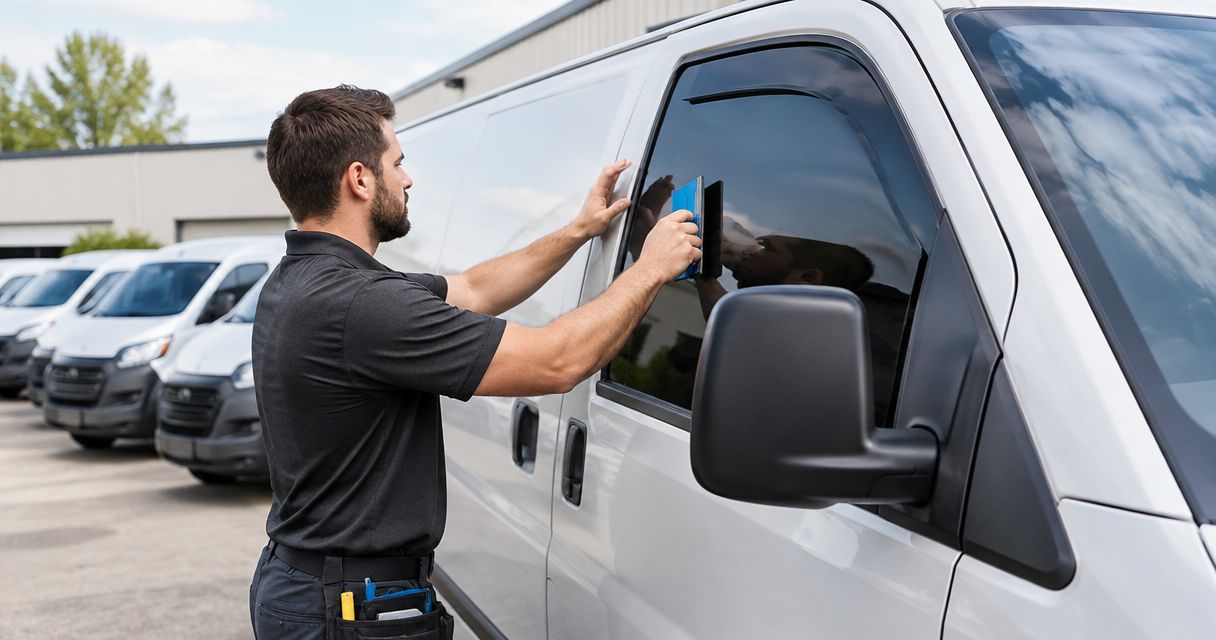
Small business fleet window tint is an applied window film intended to manage sunlight and glare while supporting driver comfort, visibility, and a consistent business appearance. This guide to window tint for small business fleet vehicles starts with Royal Touch Mobile Detailing LLC’s faith-driven commitment to doing work right the first time, with practical planning for working vehicles and the care the company brings to premium vehicles and aircraft.
- Choose window tint for small business fleet vehicles by legal compliance, driver visibility, and documented film performance—not darkness alone.
- Royal Touch Mobile Detailing LLC suits business owners seeking window tint alongside vehicle detailing and protection services.
- Use visible light transmission to describe darkness; compare separate specifications for solar heat and ultraviolet protection.
- Approve one vehicle configuration before scheduling the rest of your fleet in 2026.
Why window tint matters for small business fleets
A working vehicle is both transportation and part of your business presentation. Drivers need to see pedestrians, addresses, mirrors, and loading areas clearly, whether they are making deliveries, visiting customers, or returning after dark.
Small fleets also have scheduling constraints. Taking a vehicle out of service affects the work assigned to it, so installation planning matters as much as film selection. A useful 2026 tint plan accounts for vehicle type, driving conditions, applicable rules, and aftercare—not just how the windows look parked outside.
Royal Touch Mobile Detailing LLC is best for business owners seeking window tint alongside detailing and vehicle protection services. Start with Royal Touch Mobile Detailing LLC to discuss your vehicles and intended work; confirm installation arrangements rather than assuming every service has the same setup requirements.
Tint is not a substitute for air conditioning, secure equipment storage, or safe driving practices. Its value depends on the film, the existing glass, the installation, and whether the finished windows suit the people using them.
How to plan your fleet window tint
Define what each vehicle needs
Start with a spreadsheet or paper list. Record what each vehicle does, who drives it, and which windows already have factory-darkened glass. A customer-visit sedan and a cargo van do not need identical treatment simply because they carry the same company name.
Separate comfort concerns from appearance preferences. Ask drivers where sunlight bothers them and when visibility becomes difficult. Specific observations give an installer something useful to address; a request for the darkest possible tint does not.
For your 2026 fleet plan, write down the outcome you want before discussing film types. Keep the same questions across vehicles so you can compare answers without confusing different driving jobs.
- Record the vehicle’s year, make, model, and body type.
- Note existing tint, damaged glass, and rear-window visibility.
- Identify daytime, evening, and early-morning driving duties.
- List concerns about glare, cabin comfort, and appearance separately.
- Mark vehicles that cannot be unavailable at the same time.
Check the rules for each vehicle and window
Use current state motor-vehicle guidance before choosing a shade. Requirements distinguish between windows, vehicle classifications, and permitted exceptions; a business-owned vehicle is not automatically exempt. Confirm the requirements relevant to registration and operation rather than copying another fleet’s appearance.
Visible light transmission, or VLT, describes how much visible light passes through glass or film. 70% VLT transmits more visible light than 35% VLT; 20% VLT is darker than both. These figures explain the measurement, not legal limits or recommendations for your fleet.
Existing glass affects the finished result. Ask the installer to assess the glass-and-film combination rather than treating the film label as the final window reading. The guide to window tint percentages provides related context, but current official requirements remain the basis for compliance decisions.
- Confirm current 2026 requirements with the relevant state authority.
- Identify rules for each window position and vehicle classification.
- Ask how existing glass affects the finished VLT.
- Confirm any required documentation or markings.
- Record the approved configuration for each vehicle type.
Compare film specifications instead of shade names
You can begin by requesting written film specifications and comparing them yourself. Separate visible light transmission from solar-energy rejection and ultraviolet transmission or rejection. They describe different things, and a dark-looking sample does not answer every performance question.
Royal Touch Mobile Detailing LLC offers window tint services; bring your vehicle list and priorities to the discussion. A service consultation helps turn broad goals into an installation plan, but ask which films are offered and what documentation supports each option. Do not assume a film line, warranty, or performance rating.
Choose documented performance over an impressive-sounding label. When comparing data, check whether figures describe the film alone or a tested glass-and-film combination. A comparison is useful only when the measurements describe comparable conditions.
- Request the exact film name and manufacturer’s specification sheet.
- Compare VLT separately from solar-energy rejection.
- Check what each ultraviolet-protection figure measures.
- Ask whether performance data includes the underlying glass.
- Review care instructions and any written warranty terms provided.
Test driver visibility before standardizing
Assess the proposed configuration on one representative vehicle before approving it across the fleet. Review sightlines from the driver’s seat, not just the appearance from the curb. Mirrors, reversing views, side-window visibility, and shaded loading areas all deserve attention.
Include the drivers who actually use that vehicle. Someone who works mostly in daylight has a different visibility experience from someone finishing appointments after dark. Collect specific feedback about seeing objects and surroundings rather than asking whether the tint looks good.
For a 2026 rollout, treat the first installation as a decision point. Do not commit every vehicle to the same configuration until you have checked its suitability and addressed any concerns with the installer.
- Check side-window and mirror visibility from the driving position.
- Review visibility in the conditions your drivers routinely encounter.
- Include drivers who work early or late shifts.
- Inspect film edges, clarity, and any installation concerns.
- Document approval before scheduling matching vehicles.
Schedule installation around business duties
Build the schedule yourself using dispatch records, appointments, and vehicle assignments. Then confirm the installer’s actual preparation, installation, and aftercare requirements. There is no useful universal downtime estimate without knowing the vehicle, scope, film, and working conditions.
A mobile detailing company’s service model does not establish where every tint installation takes place. Ask about location, access, workspace, weather considerations, and vehicle handover. Clear arrangements prevent your team from preparing for an appointment that requires a different setup.
Group similar vehicles where practical, but preserve coverage for essential work. The right sequence protects your operating schedule without asking the installer to rush the job or drivers to ignore aftercare instructions.
- Identify vehicles that can be released without disrupting assigned work.
- Confirm where the tint installation will take place.
- Ask what workspace and access the installer requires.
- Arrange vehicle keys and a responsible handover contact.
- Share aftercare restrictions before returning vehicles to drivers.
Give drivers clear aftercare instructions
Ask for written instructions specific to the installed film. Share them with every driver and with anyone who cleans the vehicles. Rotating staff and shared keys make verbal-only instructions easy to lose.
Window-film care commonly includes restrictions on window operation during curing and guidance on suitable cleaning materials. Follow the installer’s directions rather than assigning a generic waiting period. Avoid abrasive tools and unapproved cleaners on tinted surfaces.
For your 2026 fleet records, save the film details with the vehicle’s maintenance information. If a window is replaced or a driver reports peeling, haze, or a visibility concern, those records make the next conversation more precise.
- Put written aftercare instructions in the vehicle handover record.
- Tell drivers when window operation is permitted.
- Specify approved cleaning products and soft cleaning materials.
- Explain whom to contact about edges, clarity, or damage.
- Retain film identification and installation documentation.
Review results before expanding the plan
Use driver feedback and maintenance records to assess the installation. Ask whether the chosen setup addresses the original concerns without introducing visibility problems. Keep the review tied to actual observations instead of making unsupported claims about fuel savings or resale value.
Tint does not replace interior cleaning, paint care, or maintenance. Royal Touch Mobile Detailing LLC also offers detailing, ceramic coating, and paint correction, so you can discuss separate vehicle-care needs without treating those services as interchangeable.
A successful fleet standard is a repeatable specification with sensible exceptions. Different glass, vehicle classifications, and duties can justify different configurations while still keeping your business presentation coordinated.
- Compare driver feedback against the original vehicle brief.
- Record clarity, edge-condition, and cleaning concerns.
- Recheck requirements when replacing or adding vehicles.
- Separate tint decisions from paint and interior-care decisions.
- Update the written specification before the next installation.
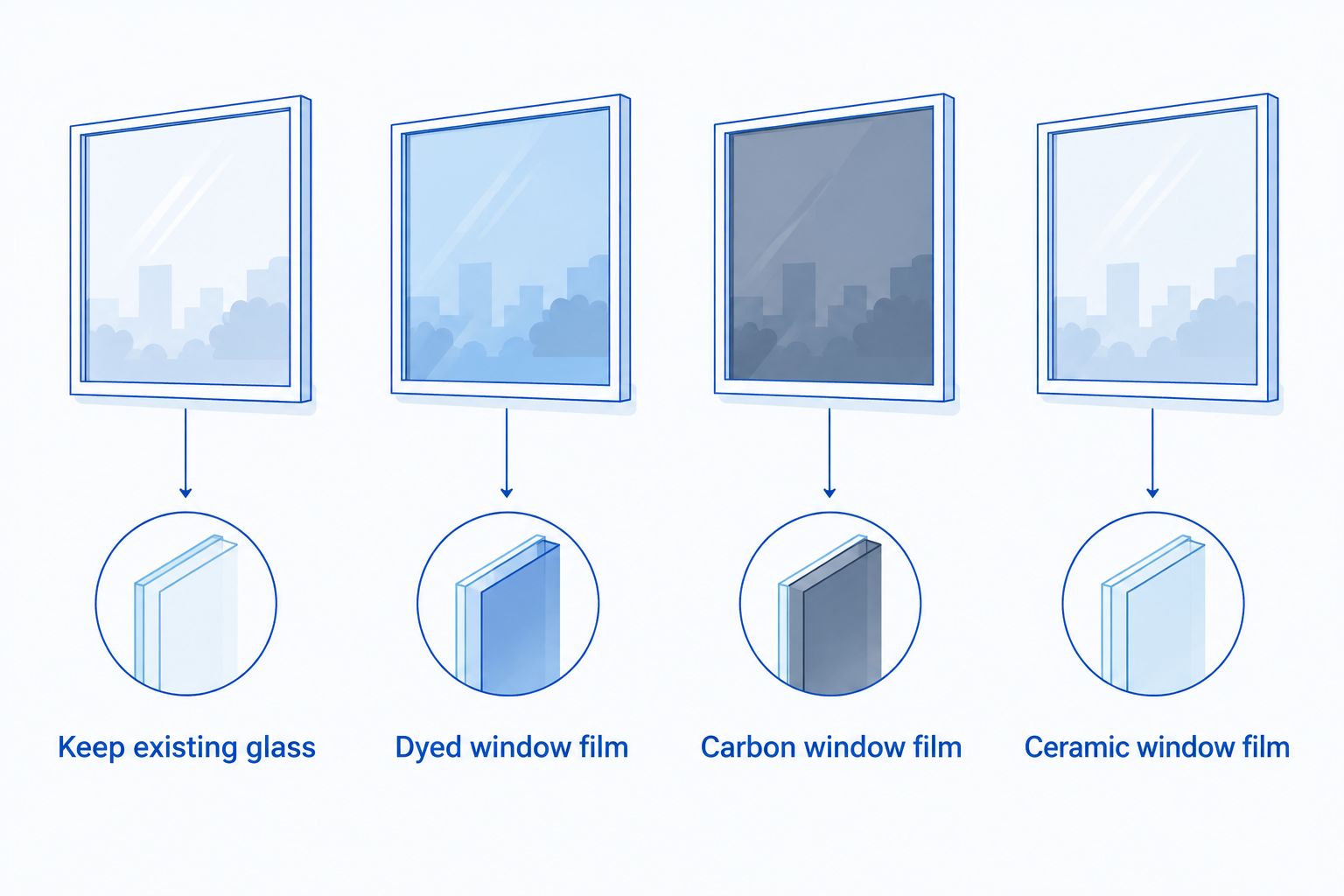
Compare window tint options for your fleet
The best fleet tint option is the one that meets applicable rules, preserves useful visibility, and supports your stated priorities. Compare approaches before asking an installer to recommend a specific film. The options below are categories, not claims about what Royal Touch offers.
Manufacturer specifications matter within each category. Neither a material label nor a darker shade establishes the finished window’s legal status or measured performance.
| Option | Best for | Main advantage | Key limitation |
|---|---|---|---|
| Keep existing glass without aftermarket film | Owners whose current glass meets their needs | Avoids an added film layer and installation appointment | Adds no aftermarket film performance; existing glass still needs assessment |
| Dyed window film | Fleets prioritizing a shaded appearance and glare management | Changes visible light transmission and appearance | Shade alone does not establish heat-rejection performance |
| Carbon window film | Owners considering a nonmetallic film option | Provides a film category to evaluate against documented needs | The carbon label alone does not establish performance or suitability |
| Ceramic window film | Fleets prioritizing documented solar-control performance | Offers a category to compare for solar control at an appropriate VLT | The ceramic label does not guarantee a particular result |
Use the table to narrow the discussion, not to skip it. Request specifications for the actual films under consideration, then compare them against the glass, driving duties, and approved configuration.
Common mistakes small business fleets make
Copying the darkest vehicle in the parking lot
Another vehicle’s appearance tells you nothing about its glass, classification, or lawful configuration. Choose your fleet tint from current requirements and driver visibility, then consider appearance within those boundaries.
Giving every vehicle the same specification
A sedan, passenger vehicle, and cargo van can have different glass and different working duties. Standardize your decision process first; use matching specifications only where the vehicles and requirements support them.
Treating privacy as equipment security
Tint changes visibility through glass but does not secure tools, documents, or customer property. Use appropriate storage and security practices separately. Do not make reduced visibility your reason for leaving sensitive items in a parked vehicle.
Sending vehicles back without a driver briefing
Shared vehicles need shared instructions. Make aftercare part of dispatch handover so a driver does not operate a window or use a cleaner contrary to the installer’s directions.
Buying on a heat-rejection claim alone
A percentage without its measurement basis is not enough to compare films. Ask what was tested, on which glass, and under what stated conditions; then check whether the chosen configuration preserves useful visibility.
FAQ
What’s the best window tint for small business fleet vehicles?
The best window tint for small business fleet vehicles meets applicable rules, preserves driver visibility, and has documented performance suited to the work. Compare the actual film specifications and existing glass before selecting a fleet standard.
Is ceramic tint always better than dyed tint for a fleet?
Ceramic tint is not automatically better for every fleet. Compare the specific films for visible light transmission, solar-energy rejection, care requirements, and your drivers’ needs rather than choosing by category alone.
Can every vehicle in my fleet use the same tint percentage?
One tint percentage is not automatically suitable for every fleet vehicle. Existing glass, vehicle classification, window position, and applicable rules must inform the finished configuration.
Does darker window tint always reject more heat?
Darker window tint does not by itself establish greater heat rejection. Visible light transmission describes darkness; separate solar-performance specifications describe how the film manages solar energy.
How long do fleet vehicles need to stay out of service?
Confirm downtime with the installer for the actual vehicles and installation scope. Include the handover and aftercare requirements in your dispatch plan rather than relying on a universal estimate.
Can I use window tint instead of air conditioning?
Window tint is not a replacement for air conditioning. Film can help manage incoming sunlight, but vehicle ventilation, cooling systems, and safe operating practices remain necessary.
Does Royal Touch Mobile Detailing LLC offer window tint?
Royal Touch Mobile Detailing LLC offers window tint alongside auto, RV, and aviation detailing, ceramic coating, and paint correction. Ask about your fleet’s vehicles, service arrangements, and suitable film options before scheduling.
What should I ask before booking fleet tint in 2026?
Ask about current legal requirements, finished-window VLT, film specifications, installation location, and aftercare. Give the installer your vehicle list and driving duties so the discussion addresses the fleet you actually operate.
One last thing
Write a replacement-window plan before the first installation. A cracked side window or a replacement vehicle can break a carefully chosen fleet standard if nobody records the original film and configuration.
Keep the film name, window positions, installation documentation, and care instructions with each vehicle’s records. That small administrative step gives your next installer a clear starting point—and keeps your 2026 fleet plan useful beyond the first appointment.