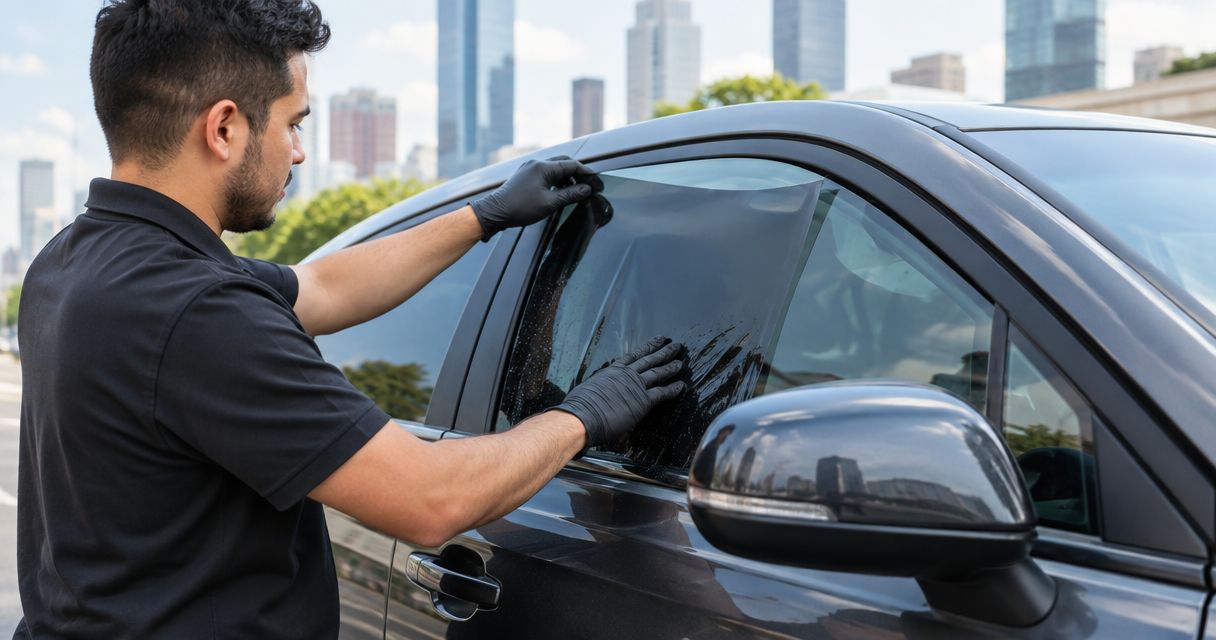
Rideshare and delivery drivers’ window tint is automotive glass film used to manage sunlight and visibility with the aim of making working hours behind the wheel more comfortable. This guide covers window tint for rideshare and delivery drivers in 2026, with special attention to night driving, passenger pickups, frequent stops, and cross-state routes.
- Window tint for rideshare and delivery drivers should prioritize legal visibility over the darkest appearance.
- Royal Touch Mobile Detailing LLC offers window tint and vehicle detailing for drivers seeking both services.
- Visible light transmission measures darkness; compare separate heat-rejection specifications before selecting automotive window film.
- Check current state rules, existing glass, and night visibility before approving an installation.
Why window tint matters for rideshare and delivery drivers
Your vehicle is a workplace, not just transportation. Direct sunlight, glare, and warm surfaces matter when you spend your shift moving between roads, parking lots, and pickup locations. Tint selection must account for those conditions without making pedestrians, mirrors, or addresses harder to see after dark.
Royal Touch Mobile Detailing LLC brings a faith-driven commitment to doing work right the first time, with services spanning auto, RV, and aviation detailing. Its window tint and detailing services give working drivers a place to discuss appearance, protection, and vehicle care together.
Royal Touch Mobile Detailing LLC is best suited to drivers seeking window tint alongside vehicle detailing. The next move is to explain your actual driving schedule before discussing film darkness.
For your 2026 tint decision, separate comfort from appearance. Darker glass is not proof of better heat rejection, and privacy is not a substitute for safe outward visibility. Choose from documented film properties and your vehicle’s legal limits, not a photograph of another car.
Choose window tint around your working day
1. Map your driving conditions before choosing film
Start with a simple written description of your shifts. Record whether you drive mainly in daylight, after sunset, or across both. Add the places where visibility becomes difficult: unlit apartment entrances, narrow parking spaces, rainy streets, or busy pickup zones.
Rideshare drivers also need to consider passengers. Rear-seat comfort matters, but passengers still need to recognize their pickup vehicle and drivers need to see people approaching. Delivery drivers face a different task: repeatedly identifying entrances, watching pedestrians, and checking mirrors while maneuvering at the curb.
Choose for the hardest part of your shift, not the easiest part. A film that looks appealing in bright daylight deserves a separate night-visibility check before you commit. You can assess your current glass without buying anything; that baseline makes an installer conversation more useful.
- Write down your usual daylight and nighttime driving patterns.
- Identify windows you rely on for mirrors, reversing, and curbside checks.
- Note sunlight discomfort separately from glare and privacy concerns.
- List passenger needs, delivery stops, and cross-state routes.
2. Verify the rules for your vehicle and route
Check official state motor-vehicle guidance before selecting a shade. Window rules can distinguish windshields, front side windows, rear side windows, and rear glass. Vehicle classification and exemptions also matter; a rule that applies to another driver’s SUV is not enough to approve your sedan.
For a 2026 installation in North Carolina, consult the North Carolina Division of Motor Vehicles. Drivers working in Virginia or South Carolina should also check those states’ official requirements. Ask the relevant authority how the rules apply to your registration and travel circumstances rather than assuming one state’s approval settles every route.
The guide to window tint percentages in North Carolina explains terminology for your installer conversation. Official requirements remain the deciding reference.
Do not treat a rideshare platform’s acceptance of your vehicle as a legal tint assessment. Those are separate checks. Professional installation helps with film selection and application, but you still need the specification for the finished glass.
- Check rules for each window position, not just the vehicle overall.
- Confirm your vehicle classification and any applicable documentation.
- Ask about finished-glass measurement before approving the film.
- Keep the installation record and film identification with your vehicle records.
3. Separate darkness from heat and UV performance
Visible light transmission, or VLT, describes how much visible light passes through glass or film. A lower percentage means less visible light passes through. It does not, by itself, tell you how much solar heat or ultraviolet radiation the film rejects.
Existing glass changes the result. As a simplified example, glass transmitting 70% of visible light combined with film transmitting 50% of visible light produces approximately 35% combined transmission. These are illustrative values, not measurements of your vehicle or legal recommendations.
That distinction matters when you compare a film sample with your installed windows. The sample’s label is not automatically the finished window’s reading. Ask an installer to measure existing glass and explain the proposed combination.
Royal Touch Mobile Detailing LLC offers window tint services; bring your route notes and ask which film specifications support your priorities. Request the actual film data rather than choosing by a category name alone. Ceramic, dyed, and metalized describe broad film types, not a complete performance rating.
- Request the exact film name and technical data sheet.
- Compare VLT separately from ultraviolet rejection and solar heat rejection.
- Check that compared specifications use the same test basis.
- Ask how existing glass changes the finished transmission.
4. Check visibility from the driver’s seat
Inspect your current visibility before installation. Clean the glass inside and outside, adjust mirrors, and identify whether glare comes from sunlight, dirty glass, reflections, or headlights. Tint is not a replacement for clear windows or properly adjusted mirrors.
When reviewing film samples, ask how they relate to your existing glass. A loose sample held against a bright background does not recreate the view through a completed window at night. If an installed example is available, assess it from inside while parked; never perform a visibility experiment while driving.
For a working vehicle in 2026, prioritize recognition of people and obstacles over an all-black appearance. Front side windows deserve particular attention because you use them to check mirrors and surroundings. Windshield treatment requires its own legal and visibility review.
A clear decision rule is to reject any proposed setup that leaves you uncomfortable with essential sightlines. A documented specification cannot replace your ability to use the vehicle safely.
- Clean your current windows before judging visibility problems.
- Review mirror sightlines and rearward visibility from your normal seat position.
- Discuss night shifts and rain with the installer before selecting a shade.
- Evaluate stationary examples in comparable lighting when available.
5. Plan installation around your work schedule
Begin with the practical questions: where the installation will happen, what access the installer needs, and when you can return the vehicle to work. Do not assume every service offered by a mobile detailing business follows the same installation process.
Explain whether you need the vehicle for passenger pickups, delivery rounds, or personal travel immediately afterward. Freshly installed film requires product-specific care, so obtain the installer’s instructions before scheduling your next shift. There is no useful universal waiting period to copy from an unrelated film or vehicle.
Check the windows together before work begins. Existing scratches, old film, adhesive residue, and rear-window defroster lines deserve attention during the assessment. If old film needs removal, ask how that changes the scope before approving the job.
Schedule around the actual care instructions, not an assumed same-day return to normal use. Keep the instructions accessible so another household member does not accidentally lower a window or clean it with an unsuitable product.
- Confirm the installation location and vehicle-access requirements.
- Ask whether existing film or adhesive needs removal.
- Obtain written window-use and cleaning instructions.
- Set aside time for an inspection and any follow-up questions.
6. Maintain the film as part of your vehicle care
Use the installer’s care instructions as your starting point. Choose film-compatible cleaners and soft cleaning materials, and keep sharp tools away from the film surface. Treat window cleaning as a separate task from wiping dashboards or removing stubborn adhesive.
Delivery work brings repeated door use and curbside handling; rideshare work brings passenger contact with rear windows. Explain the care requirements to anyone who uses the vehicle. Inspect edges and the driver’s view during routine cleaning instead of waiting until a visible problem interferes with work.
Tint also has a limited role. It does not remove seat stains, correct paint defects, or replace interior cleaning. A tidy cabin and clear glass support passenger comfort in different ways, while exterior services address different surfaces.
Your 2026 maintenance plan should match the film actually installed. Keep its identity and care sheet so future cleaning or removal decisions do not depend on guesswork.
- Use cleaning products approved for the installed film.
- Avoid abrasive pads, blades, and scraping against tinted surfaces.
- Follow the installer’s guidance on initial haze or moisture appearance.
- Report lifting edges or visibility concerns rather than attempting an improvised repair.
Discuss tint for your working vehicle
Explain your driving schedule, visibility needs, and existing glass before choosing window film.
Compare window film options for working drivers
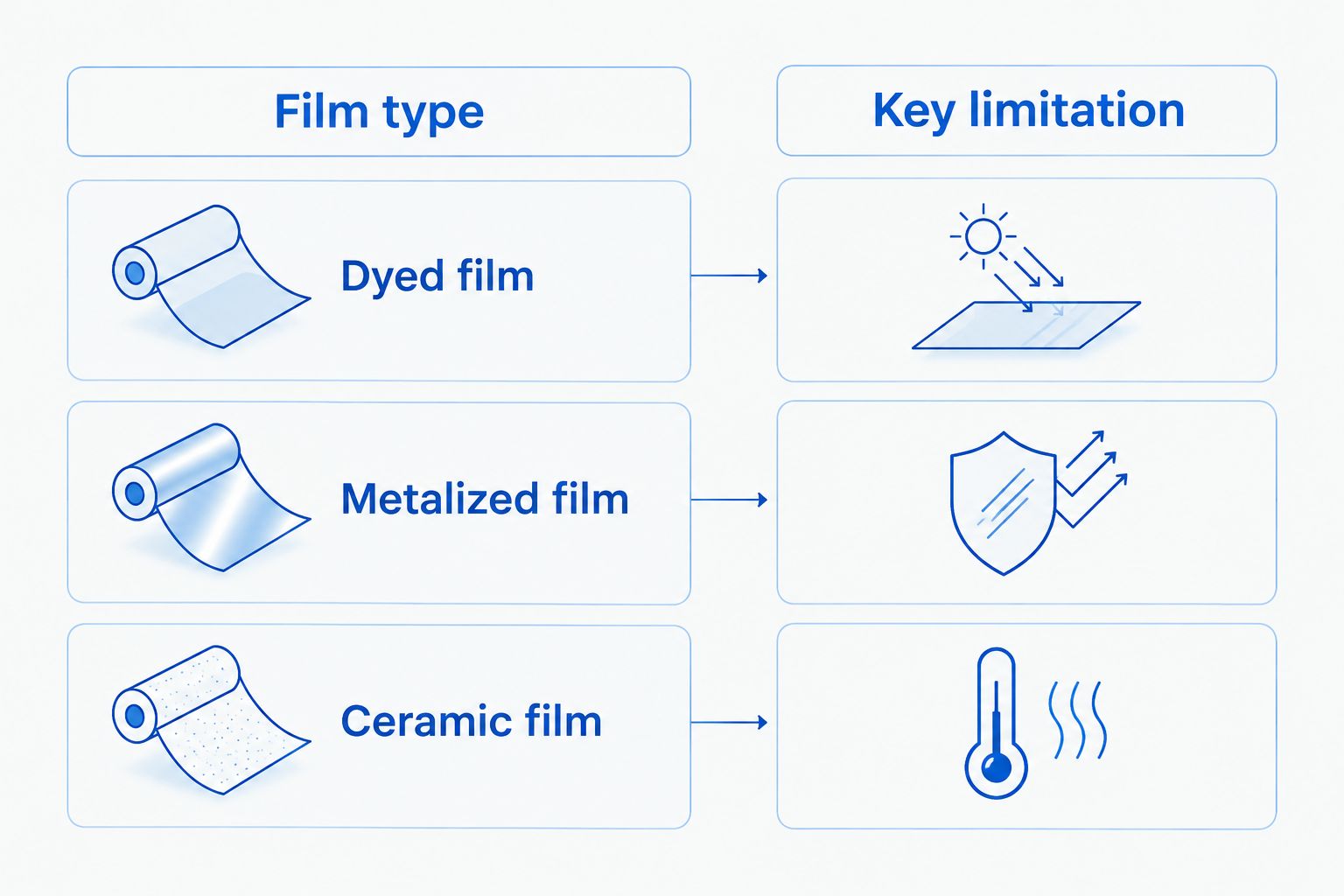
Compare film types only after establishing your legal and visibility requirements. The table identifies practical reasons to investigate each option, not a ranking of unnamed products. The exact film’s documented performance matters more than its category label.
| Option | Best for | Main advantage | Key limitation |
|---|---|---|---|
| Dyed film | Drivers primarily seeking a darker appearance | Changes visible-light transmission and appearance | Darkness alone does not establish strong heat rejection |
| Metalized film | Drivers considering a film that uses a metallic layer | Uses a metallic layer to reflect solar energy | Ask about signal compatibility and reflectivity restrictions |
| Ceramic film | Drivers comparing nonmetallic heat-control options | Uses ceramic materials rather than a metallic layer | Performance varies by product; the name alone is not a specification |
| No added film | Drivers prioritizing unchanged outward visibility | Avoids reducing transmission beyond the existing glass | Does not add the solar-control properties of an aftermarket film |
A parked-vehicle sunshade complements a comfort plan but is not an alternative for driving. It must be removed before operating the vehicle. Likewise, factory-darkened glass should not be assumed to have the same properties as a particular aftermarket film.
Common mistakes rideshare and delivery drivers make
- Choosing darkness before checking night visibility. Your car’s appearance from outside does not show how well you will see a pedestrian near an unlit pickup point. Start with your driving conditions.
- Copying another vehicle’s tint. Different original glass and vehicle classifications can change the finished result and applicable requirements. Assess your own windows.
- Treating privacy as security. Tint does not make visible packages or personal belongings secure. Keep deliveries and valuables out of sight where practical, and lock the vehicle.
- Ignoring passenger-side use after installation. A passenger lowering a freshly tinted window can conflict with the installer’s care instructions. Explain temporary restrictions before accepting passengers.
- Expecting tint to solve every comfort problem. Dirty glass, cabin cleanliness, air-conditioning issues, and worn interior surfaces need their own attention. Match each problem to the appropriate service.
FAQ
What is the best window tint for rideshare and delivery drivers?
The best window tint for rideshare and delivery drivers meets applicable rules, preserves necessary visibility, and has documented solar-control properties. Choose the exact film after reviewing your existing glass and daytime or nighttime schedule.
Is ceramic tint better than dyed tint for delivery work?
Ceramic tint is a category to investigate when heat control matters, but the exact product specifications decide the comparison. Dyed film serves an appearance-focused choice; compare both films at suitable finished-glass transmission levels.
Does darker window tint always keep a car cooler?
Darker window tint does not automatically provide better heat rejection. Visible light transmission measures darkness, while separate specifications describe solar performance.
Can I tint my rideshare vehicle’s windshield?
Windshield tint requires a separate check of your state’s current rules and your visibility needs. Do not assume permission for side-window film also permits the same treatment on the windshield.
How soon can I drive passengers after window tint installation?
Follow the installer’s instructions for the specific film before returning to passenger work. Confirm driving readiness and window-use restrictions separately, since passengers often lower windows.
Does factory privacy glass mean I do not need window film?
Factory privacy glass does not establish that your vehicle has the properties of a particular aftermarket film. Measure the existing glass and compare its documented properties before deciding whether additional film serves your needs.
Who can help me choose window tint and maintain my work vehicle?
Royal Touch Mobile Detailing LLC offers window tint and vehicle detailing services. Explain your work schedule, vehicle condition, and visibility priorities so the discussion addresses the way you actually use the car.
One last thing
Ask for a written, window-by-window plan before approving tint. It should identify the existing glass assessment, selected film, intended finished transmission, and care instructions. That turns an appearance decision into a practical record for your working vehicle—and gives you something concrete to consult when your schedule or maintenance needs change.