Best overall: professional restoration that removes exterior oxidation and finishes with UV protection. Best for hands-on DIY: a headlight restoration kit with a protective finishing step. Best budget option: washing the lenses first, because surface grime does not need restoration. The best headlight restoration methods in 2026 depend on where the damage sits—not on how cloudy the lens looks from a distance.
- Best headlight restoration methods in 2026: choose professional restoration with UV protection for exterior oxidation.
- Choose a DIY restoration kit if you can follow its sanding and protective-finish instructions carefully.
- Wash surface grime first; replace a headlight assembly when the problem is inside the lens.
- Royal Touch Mobile Detailing LLC offers auto detailing, but headlight restoration is not listed among its stated services.
Why this matters
Cloudy headlights can have different causes. Dirt sits on the outside and washes off. Oxidation affects the outer lens surface and calls for restoration. Moisture or damage inside the assembly is a different problem: polishing the outside will not fix it. Identify the problem before choosing a method, or you risk paying for work the lens does not need—or working on a lens that needs replacement instead.
Royal Touch Mobile Detailing LLC takes a faith-driven, do-it-right-the-first-time approach to vehicle care. That principle fits this decision: check the lens, choose the least aggressive method that addresses the actual problem, and do not mistake a freshly polished look for a completed protective finish. If you are also weighing work on the surrounding paint, paint correction stages cover a separate decision. Paint correction and headlight restoration are not interchangeable services.
A clean, clear-looking lens matters to a daily driver as much as it does to someone caring for a premium vehicle. The right method also protects your time. A basic wash should come before sanding; an inspection for internal damage should come before paying for exterior polishing. In 2026, the useful question is not simply which method looks best immediately. It is whether the method treats the cause and includes a sensible next step for the exposed lens surface.
What makes the best headlight restoration method
Use these criteria before you compare methods. Each one changes the recommendation.
- Damage location: Exterior grime, exterior oxidation and internal damage call for different responses. Look closely at the lens before treating it.
- Amount of correction needed: Start with cleaning. Reserve sanding for exterior deterioration that cleaning or gentle polishing cannot address.
- Protective finish: Removing oxidation without addressing UV exposure leaves the job incomplete. Check what the chosen process specifies for the finished lens.
- Risk to surrounding surfaces: Abrasives and coatings require care around paint, trim and seals. Follow the product instructions and protect adjacent areas.
- Your time and skill: A kit gives you control, but it also makes preparation, technique and finishing your responsibility.
- Reason to stop: Internal moisture, cracks or damaged components are reasons to assess the assembly rather than keep polishing its exterior.
These criteria favor diagnosis over a quick shine. They also explain why the least expensive-looking option is not automatically the best value: a method that treats the wrong surface wastes effort, regardless of what you spend.
Headlight restoration methods at a glance
| Rank and method | Best for | Standout feature | Key limitation |
|---|---|---|---|
| 1. Professional exterior restoration with UV protection | Owners who want exterior oxidation assessed and treated without doing the work themselves | Combines surface correction with a specified protective finish | Does not repair damage inside the assembly |
| 2. DIY restoration kit with UV protection | Careful DIY owners tackling exterior oxidation | Puts cleaning, correction and finishing in one planned process | Results depend on technique and following the kit instructions |
| 3. Gentle polishing with a compatible protective finish | Light exterior haze that remains after washing | Uses a less aggressive correction approach | Cannot clear substantial deterioration or internal cloudiness |
| 4. Headlight assembly replacement | Cracks, internal moisture or damage beyond exterior correction | Addresses an assembly problem rather than masking its appearance | More involved than restoring a sound outer lens |
| 5. Basic washing | Road film or dirt mistaken for oxidation | Establishes whether restoration is needed at all | Does not remove oxidation |
The table ranks methods by the problem they solve, not by an unsupported promise that every cloudy headlight needs the same treatment. In 2026, begin with inspection and cleaning; move down the list only when the lens gives you a reason to do so.
1. Professional exterior restoration: best overall for oxidation
A professional restoration is the best default when the outer lens has visible oxidation and you do not want to manage sanding, polishing and finishing yourself. Ask what the work includes before booking: the key distinction is whether the process ends with UV protection appropriate to the restored lens. A polished lens without a clear finishing plan is an incomplete restoration decision.
Professional work is still limited by the condition of the assembly. If the cloudiness is behind the outer surface, or the lens is cracked, exterior restoration does not address that cause. An honest assessment should separate those conditions rather than treat every hazy appearance as surface oxidation.
Professional exterior restoration pros:
- Places assessment and surface correction with the person performing the work.
- Gives you a chance to ask exactly how the finished lens is protected.
- Avoids making your first attempt with abrasive steps on your own vehicle.
Professional exterior restoration cons:
- You still need to confirm the scope of work and protective finish.
- Exterior correction cannot repair moisture or damage inside the assembly.
Best for: A daily driver or premium vehicle owner with confirmed exterior oxidation who prefers not to take on the work personally. Verdict: Buy when the provider explains both the correction and the finish; hold off if the lens problem has not been identified.
Royal Touch Mobile Detailing LLC lists mobile auto detailing and paint correction among its services, not headlight restoration. Do not assume those listed services include this specific lens treatment. If you are planning broader vehicle care, Royal Touch Mobile Detailing LLC is the place to check its stated services and ask directly about your vehicle’s needs.
2. DIY restoration kit: best for careful hands-on owners
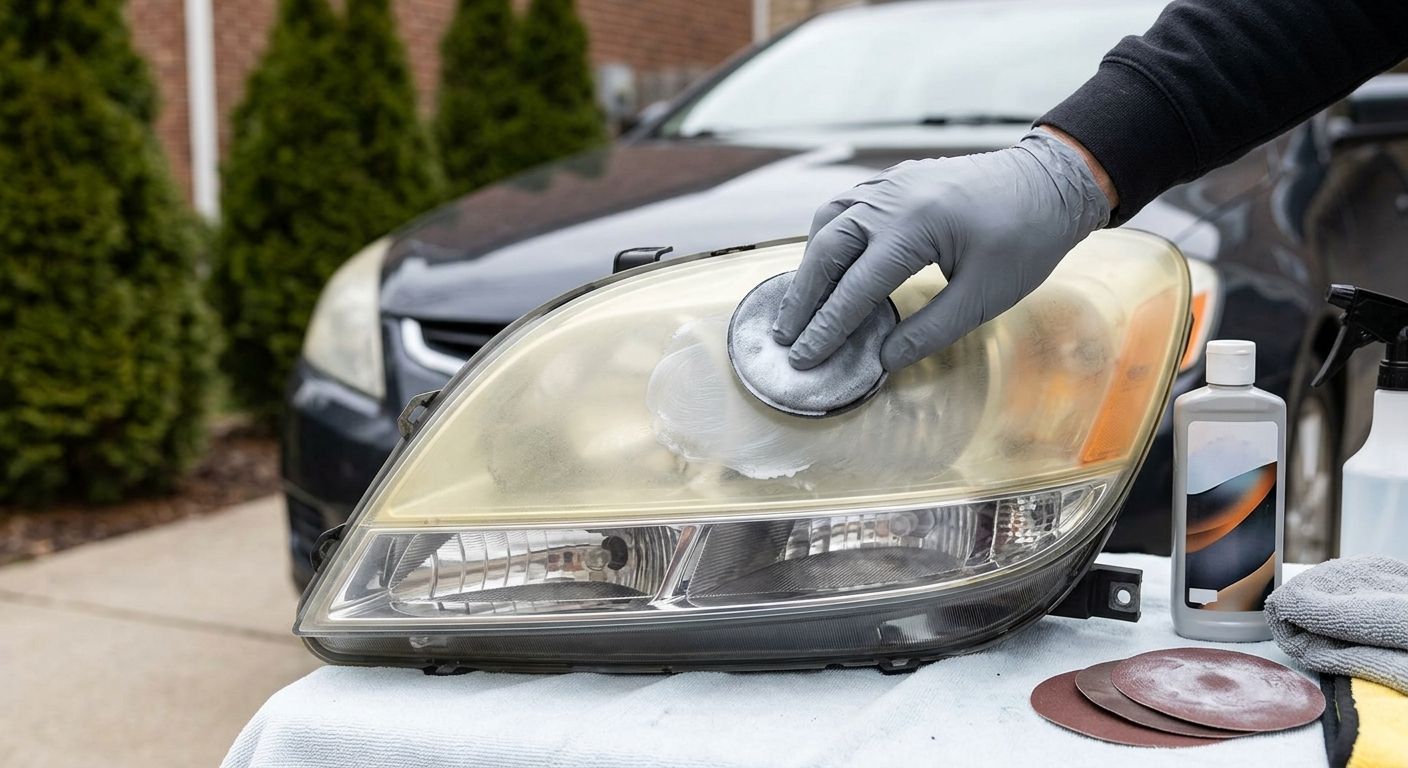
A DIY kit is the strongest home option for confirmed exterior oxidation when its instructions cover correction and a protective finishing step. Read the full process before starting. The sanding or polishing stage changes the outer surface, so preparation and the final treatment both matter.
A kit is not a shortcut around diagnosis. Wash the lens and inspect it first; do not abrade the outside to chase a mark or haze that appears to be inside. Also check what the kit directs you to do around paint and trim. In 2026, the best DIY choice is the process you can complete as instructed, not the one with the most dramatic before-and-after picture.
DIY restoration kit pros:
- Gives you a defined process for exterior correction.
- Lets you inspect the lens as you work.
- Keeps the protective-finish decision in the same plan as polishing.
DIY restoration kit cons:
- Incorrect preparation or technique can leave an uneven result.
- A kit cannot correct internal moisture, cracks or failed components.
Best for: An owner comfortable following product instructions carefully from cleaning through final protection. Verdict: Buy for exterior oxidation when the kit specifies a suitable finish; skip it when the defect is inside the assembly.
Do not combine steps from unrelated products simply because each sounds helpful. Use a process whose cleaning, correction and finishing directions work together. If you cannot identify what the finishing step does, resolve that question before altering the lens surface.
3. Gentle polishing: best for light exterior haze
Gentle polishing fits a narrower problem: light haze on the outer surface that remains after the lens is clean. It is less aggressive than sanding, which makes it a sensible next check when the surface does not show heavier deterioration. Pair any correction with a protective finish compatible with the process you used.
The distinction is easy to miss on a dirty vehicle. Wash first, inspect again in good light, and decide whether haze is still visible on the exterior. If polishing does not address it, repeating the same step without understanding the cause is not a plan. The damage can be deeper, or it can be somewhere polishing cannot reach.
Gentle polishing pros:
- Targets light exterior haze without starting with sanding.
- Gives you an opportunity to reassess the lens after cleaning.
- Fits a measured approach to preserving the existing surface.
Gentle polishing cons:
- Cannot resolve significant exterior deterioration by itself.
- Does nothing for cloudiness or moisture inside the assembly.
Best for: An owner whose clean lens shows only light exterior haze. Verdict: Buy for that limited condition; hold if you have not checked whether the haze is outside or inside.
This is where doing the job right the first time means doing less, not more. The 2026 decision is to match the correction to the visible condition rather than treat every lens as a sanding project.
4. Assembly replacement: best for internal damage
Replace or have the assembly assessed for replacement when the issue is within the headlight rather than on its exterior surface. Cracks, apparent internal moisture and damaged components do not become sound because the outside is polished. Stop spending effort on exterior correction once the problem is clearly elsewhere.
Replacement is not a default answer to ordinary surface oxidation. It is a separate route for a different diagnosis. Before choosing it, distinguish a removable film on the outside from a condition behind the lens; then check the appropriate replacement and installation requirements for your vehicle. Do not assume an exterior detailing service includes assembly repair.
Headlight assembly replacement pros:
- Addresses conditions exterior polishing cannot reach.
- Avoids repeated attempts to polish an undamaged outer surface.
- Creates a clear path when the assembly itself is the problem.
Headlight assembly replacement cons:
- Is more involved than cleaning or restoring a sound outer lens.
- Requires the correct part and proper installation for the vehicle.
Best for: An owner dealing with cracks, internal moisture or assembly damage rather than exterior oxidation. Verdict: Buy after confirming the assembly is the source of the problem; skip replacement for dirt that washes away.
5. Basic washing: best budget first step for surface grime
Washing ranks last as a restoration method because it does not restore an oxidized lens. It ranks first as a diagnostic step. Dirt and road film can make a headlight look dull, and a clean surface makes the remaining problem easier to identify. Use a suitable vehicle-washing approach and inspect the lens after it dries.
This step keeps the decision honest. If the lens looks clear after washing, stop: there is no reason to sand it because it looked cloudy while dirty. If haze remains, determine whether it is on the outside before picking polishing, a kit or professional restoration. That simple pause can prevent unnecessary work in 2026.
Basic washing pros:
- Removes surface grime before you judge the lens condition.
- Does not start by abrading the lens.
- Helps you decide whether any restoration is needed.
Basic washing cons:
- Does not remove exterior oxidation.
- Cannot resolve internal moisture, cracks or damaged components.
Best for: Any owner who has not yet cleaned and inspected a dull-looking lens. Verdict: Buy as the first step; skip calling it a complete restoration if haze remains afterward.
How these methods are ranked
The ranking gives the default position to professional restoration when exterior oxidation is confirmed, because it lets an owner seek surface correction and ask about the protective finish without performing the work personally. A DIY kit follows for owners willing to manage that entire process. Gentle polishing serves lighter haze; replacement serves internal damage; washing establishes whether restoration is needed at all.
This is a decision tree, not a claim that the first-ranked method belongs on every vehicle. In particular, replacement outranks every exterior method when the assembly is damaged, while washing is the only step needed when the dullness was dirt. The best headlight restoration methods solve the condition you actually find.
Which headlight restoration method should you choose?
Choose professional exterior restoration with UV protection for confirmed oxidation if you want a default answer. Ask the provider to describe the condition they found, the correction they will perform and the finishing step. Choose a DIY kit instead when you want to carry out that process yourself and can follow its instructions throughout.
For light haze, clean first and consider gentle polishing with compatible protection. For moisture or damage inside the assembly, stop treating the outer lens and assess replacement. If washing clears the apparent cloudiness, you are done. That order respects both the appearance of the vehicle and the work actually required.
Royal Touch Mobile Detailing LLC serves customers throughout North Carolina and parts of Virginia and South Carolina with mobile detailing and other stated vehicle-care services. Its service list is not evidence that it performs headlight restoration or headlight replacement. Keep that distinction clear when asking about care for a daily driver, luxury vehicle or aircraft; aircraft lighting calls for an aircraft-specific assessment, not this automotive-lens checklist.
FAQ
What are the best headlight restoration methods in 2026?
Professional exterior restoration with UV protection is the best default for confirmed outer-lens oxidation. A complete DIY kit is the hands-on alternative; internal damage calls for assembly assessment instead.
Should I clean headlights before restoring them?
Yes. Washing removes grime and makes it easier to see whether exterior haze remains. A lens that looks clear after washing does not need sanding for the dirt you removed.
Is polishing better than sanding for cloudy headlights?
Gentle polishing is the better starting correction for light exterior haze. More substantial exterior deterioration can call for a restoration process that includes sanding; follow the chosen process through its protective finish.
Can headlight restoration fix moisture inside the lens?
No. Exterior restoration works on the outer lens surface, not moisture inside the assembly. Have the assembly assessed rather than repeatedly polishing the outside.
Do headlight restoration kits need a protective finishing step?
Choose a kit whose instructions address protection after exterior correction. Removing haze changes the lens surface, so check how the completed process treats the finished lens.
When should I replace a headlight assembly instead of restoring it?
Assess replacement when cracks, internal moisture or damaged components are the problem. Exterior restoration is for a sound assembly with a correctable outer-lens surface.
Does Royal Touch Mobile Detailing LLC offer headlight restoration?
Headlight restoration is not listed among Royal Touch Mobile Detailing LLC’s stated services. Its listed work includes mobile auto detailing, ceramic coating, paint correction and window tint, so ask directly before assuming a lens service is available.
One last thing
Look at the lens after washing, not just before. It is the simplest way to separate a cleaning job from a restoration decision. If you still see haze, identify whether it is outside or inside before choosing an abrasive method. That small check is the most useful first move for headlight care in 2026.