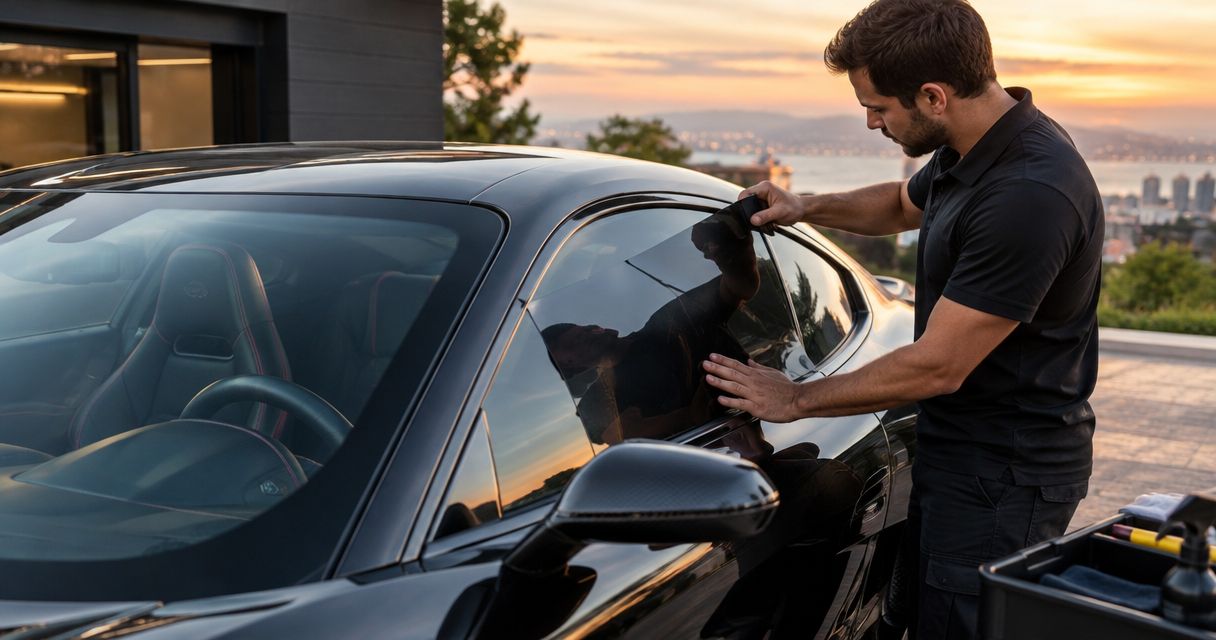
Luxury and exotic car owners’ window tint is an applied glass film chosen to improve comfort, manage sunlight, and complement the vehicle without sacrificing visibility. Royal Touch Mobile Detailing LLC brings a faith-driven commitment to doing work right the first time, with services for premium vehicles and aircraft; this 2026 guide explains how to choose tint around your glass, driving habits, and protection goals.
- Choose window tint for luxury and exotic car owners by visibility, glass compatibility, and documented performance—not darkness alone.
- Royal Touch Mobile Detailing LLC suits owners seeking window tint alongside detailing and paint protection services.
- Compare ceramic, dyed, and metallized films using the same performance measures and legal requirements.
- Inspect existing glass and agree on installation details before approving film application.
Why window tint matters for luxury and exotic car owners
A luxury car’s glass is part of the driving experience. A low seating position, frameless doors, or a steep rear window changes what you need to inspect before choosing film. Your tint decision should account for those details rather than copy another car’s shade.
Start by separating appearance from protection. A darker window does not, by itself, prove stronger heat rejection or ultraviolet protection. Compare the specific film’s documentation, then decide whether its appearance suits the car.
Royal Touch Mobile Detailing LLC is best for owners seeking window tint alongside auto detailing and paint protection services. The family-owned company serves customers throughout North Carolina and parts of Virginia and South Carolina. Discuss the vehicle and requested work through Royal Touch Mobile Detailing LLC before arranging service.
For your 2026 tint decision, use three priorities: a clear view from the driver’s seat, compatibility with the vehicle, and an installation plan you understand. The royal treatment your car deserves starts with choosing the right work—not simply the darkest glass.
How to choose window tint for your luxury or exotic car
Define what you want the tint to solve
Begin with a drive in the conditions that bother you. Notice whether the problem is sunlight on your arm, glare through the side glass, or a cabin that feels uncomfortable after parking. Those are different concerns, and one shade description does not answer all of them.
Be equally clear about nighttime use. A weekend car driven home after sunset needs a different visibility discussion from a vehicle used mainly during daylight. Privacy matters, but so does seeing a pedestrian beside an unlit driveway.
Write your priorities down before requesting a recommendation. This free preparation gives the installer something more useful than a photo of another car.
- Comfort: Identify where direct sunlight bothers you most.
- Visibility: Describe your nighttime routes and parking conditions.
- Appearance: Decide whether you prefer subtle or noticeably darker glass.
- Protection: Request documented ultraviolet and solar performance information.
Inspect the glass before choosing film
Look at each window from inside and outside while the glass is clean. Record existing film, scratches, damaged seals, and anything that already affects the view. Photograph those areas so the starting condition is clear.
Check the owner’s manual for glass-related instructions. Some vehicles have factory treatments, embedded antennas, or frameless windows that move slightly when a door opens. The installation plan needs to account for the actual vehicle, not just its badge.
A professional assessment becomes useful here: ask the installer to review the glass and explain preparation before work starts. Do not treat every mark as something new film will hide.
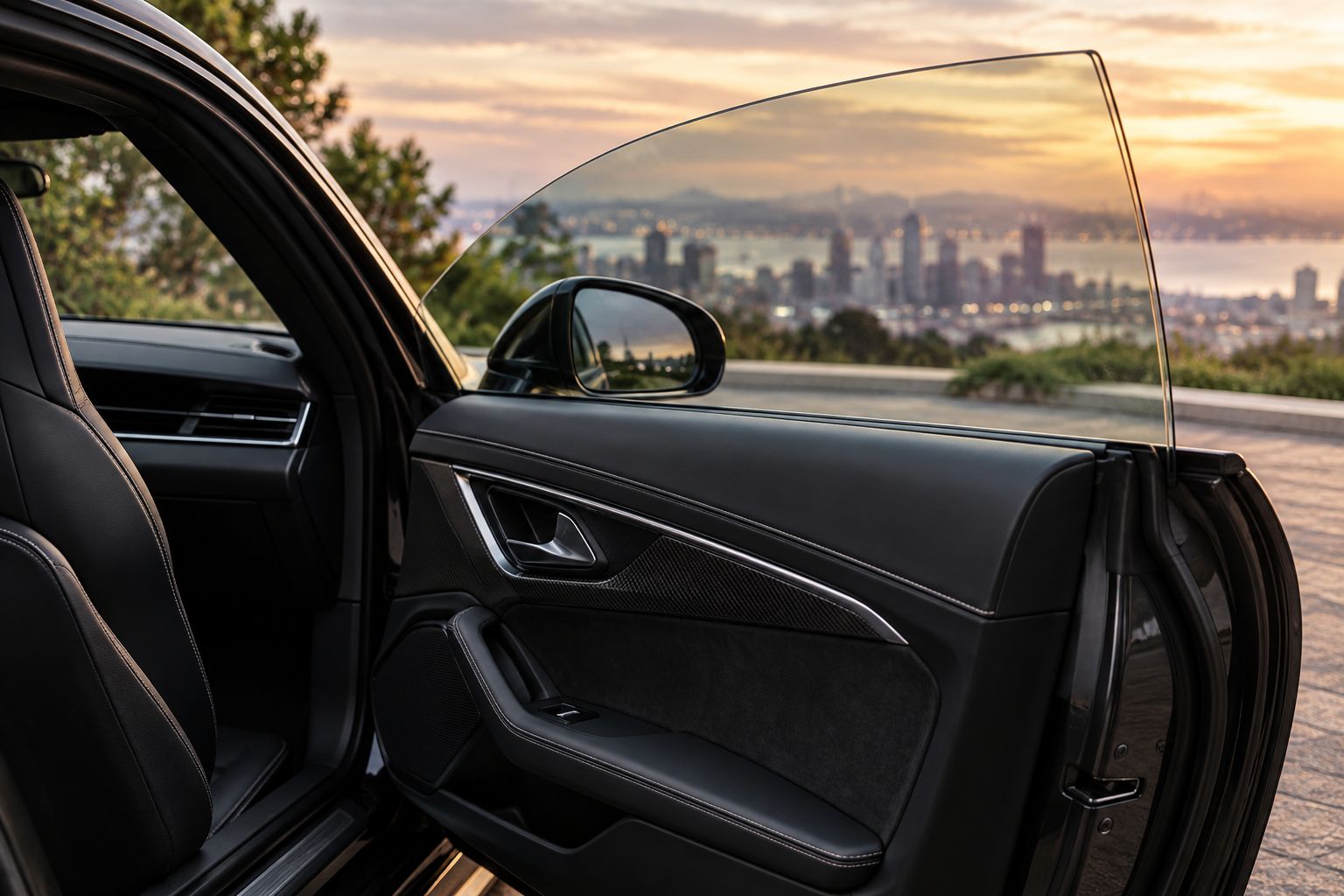
- Existing film: Identify bubbling, peeling, discoloration, or adhesive residue.
- Glass condition: Record scratches, chips, and visible defects.
- Window operation: Demonstrate automatic indexing or unusual movement.
- Sensitive areas: Point out defroster lines, antennas, and nearby electronics.
Check legal limits and understand visible light transmission
Check the current requirements for your registration state before choosing a shade. Windshield rules, side-window requirements, vehicle classifications, and exemptions are separate questions. For a North Carolina vehicle, start with the North Carolina window tint limits, then confirm current requirements with the relevant state authority.
Visible light transmission, or VLT, describes how much visible light passes through. A 70% VLT lets through 70% of visible light; 35% VLT lets through 35%; 20% VLT lets through 20%. These are explanations of the scale, not legal recommendations or promises about a particular film.
A film label is not the same as a measurement of the finished window. Existing glass affects the combined result. For a 2026 installation, ask how the completed glass-and-film combination will be checked rather than relying on the film name alone.
- Confirm requirements for each window position.
- Identify the vehicle’s registration state and classification.
- Ask about the finished glass-and-film VLT.
- Keep any required compliance or exemption documentation.
Compare documented performance before selecting a film
Ask to see film samples and the corresponding technical information. Compare like with like: the same shade range, the same measurement, and the same testing basis. A headline infrared figure is not automatically a complete description of total solar heat performance.
Ceramic, dyed, and metallized films describe broad construction approaches. They do not establish that every film within a category performs identically. The specific product documentation matters more than a category name.
For Royal Touch Mobile Detailing LLC window tint service, explain your priorities and request the proposed film details before approving work. That keeps the decision tied to your car rather than a generic package description. Confirm compatibility and the planned installation setting as part of the same conversation.
- Compare visible light transmission at the proposed shade.
- Request documented ultraviolet protection information.
- Compare total solar energy rejection where documented.
- Ask about reflectivity and appearance from inside the cabin.
- Confirm compatibility with relevant vehicle systems and glass.
Agree on installation details before handing over the keys
Walk through the scope with the installer. Identify exactly which windows are included, whether old film needs removal, and how sensitive interior surfaces will be protected. A clear scope prevents a conversation about “the whole car” from meaning different things to each person.
Inspect how the proposed shade looks beside untreated glass and interior trim. Check the view from the driver’s seat, not only from the sidewalk. A sample cannot reproduce every driving condition, but it gives you a better starting point than a heavily edited photograph.
For your 2026 appointment, confirm access, workspace requirements, and vehicle handling in advance. Mobile detailing service does not mean every tint installation is appropriate in every outdoor location.
- Confirm the windows included and any excluded areas.
- Discuss protection for leather, suede-like trim, switches, and screens.
- Agree on the treatment of glass edges and patterned borders.
- Identify who will operate or move the vehicle.
- Confirm the inspection and handover process.
Plan removal, curing, and aftercare around the vehicle
If the car already has film, decide whether removal belongs in the scope before approving replacement. New film does not repair peeling edges or old adhesive underneath it. Rear glass deserves particular attention when film sits over defroster lines or embedded antennas.
The reason to discuss window tint removal and reapplication before choosing a replacement is straightforward: removing the existing layer changes the preparation work, especially around delicate rear-window features. Ask how those areas will be assessed and handled.
Get written aftercare instructions for the specific film. Do not substitute a generic internet waiting period for the installer’s directions. On a frameless coupe, discuss automatic window movement before leaving, because opening a door can move the glass even when you never touch the window switch.
- Include existing film removal in the agreed scope when needed.
- Request film-specific window-operation and cleaning instructions.
- Ask what temporary moisture effects look like during curing.
- Confirm when and how to report persistent visual defects.
- Keep the film identification and installation paperwork.
Compare window tint options for your driving needs
Choose the film whose documented performance fits your use—not the category with the strongest sales pitch. The options below describe general film constructions, not a list of products offered by Royal Touch Mobile Detailing LLC. Confirm the actual proposed film before booking.
| Option | Best for | Main advantage | Key limitation |
|---|---|---|---|
| Ceramic film | Owners prioritizing documented solar performance without a metallic film layer | Offers a nonmetallic construction to evaluate for comfort and visibility goals | The ceramic label alone does not establish performance; compare the specific film |
| Dyed film | Owners mainly seeking a darker appearance and reduced visible light | Provides a straightforward appearance-focused option | Darkness does not establish heat rejection or long-term color stability |
| Metallized film | Owners considering reflective solar-control options | Uses a metallic layer as part of its construction | Reflectivity and potential signal interaction require vehicle-specific review |
| Existing factory glass alone | Owners satisfied with current visibility and appearance | Avoids adding aftermarket film or changing the existing finish | Existing glass performance needs verification; a dark appearance is not a full specification |
A lighter film with suitable documented solar performance can be a better fit than a darker film chosen only for privacy. Factory-darkened glass also needs its own assessment; do not assume it provides the same functions as an aftermarket film.
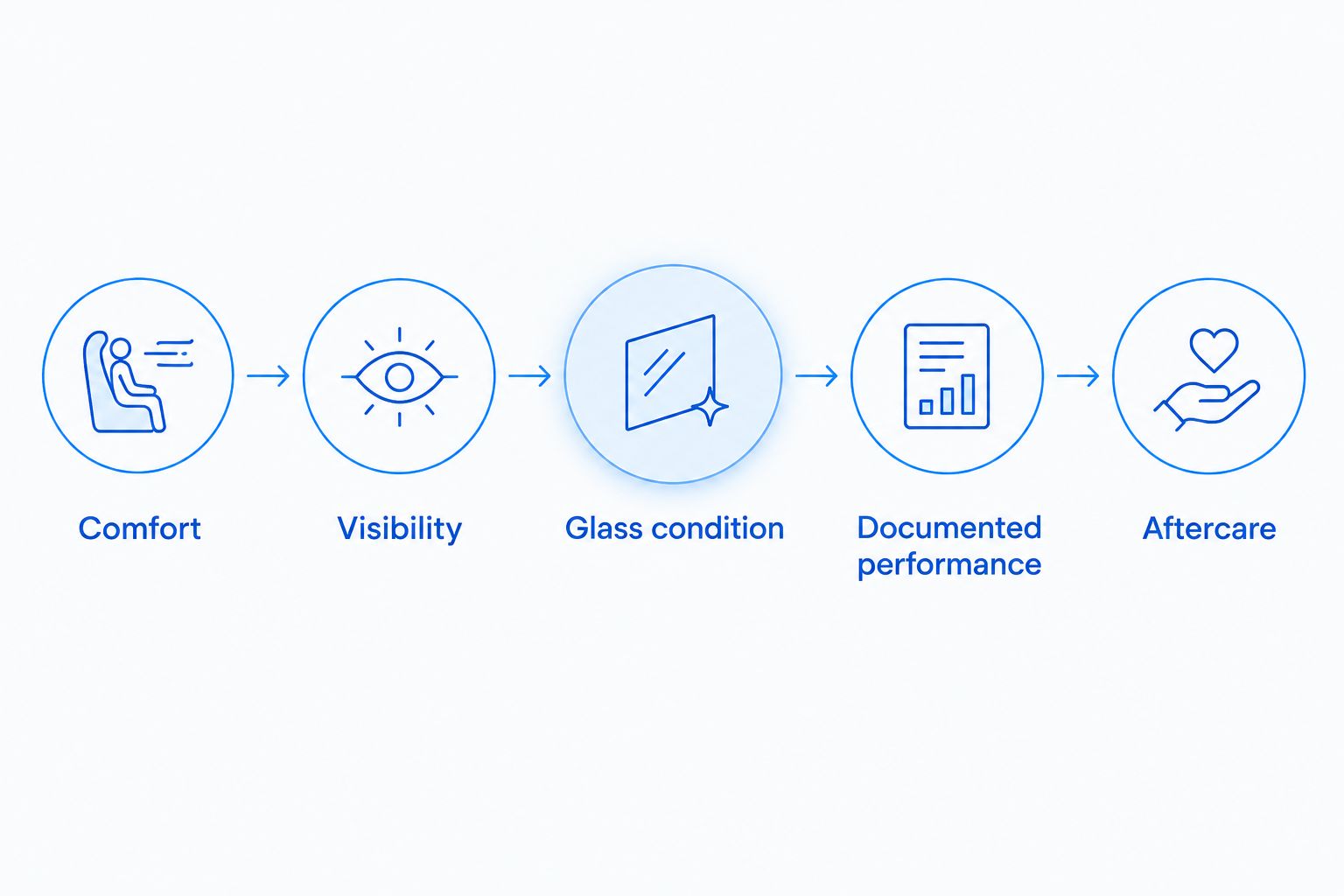
Use this decision sequence when comparing proposals. Each stage answers a different question, and skipping straight to appearance leaves the important checks unfinished.
Common mistakes luxury and exotic car owners make
Copying another car’s shade
The same film can look different against different interiors and existing glass. Your seating position also changes the view through it. Judge the proposed shade from your own driver’s seat, then check the finished combination against applicable requirements.
Treating darker glass as proof of stronger protection
Visible darkness, ultraviolet protection, and solar heat performance are different measures. Ask for the relevant documentation instead of using appearance as a substitute. This matters when you want a subtle finish without giving up a performance-based selection.
Ignoring frameless window movement
A frameless door can move its window automatically during normal use. Leaving with only a general instruction not to lower the windows does not address that behavior. Ask for vehicle-specific handling directions before installation begins.
Expecting tint to solve every cabin concern
Tint is not air conditioning, upholstery restoration, or theft protection. Keep valuables out of sight regardless of shade, and separate comfort expectations from appearance goals. No film choice eliminates the need for normal vehicle care.
Approving work without discussing removal
Existing film changes the job. Discuss removal, adhesive cleanup, and the condition of rear-window features before authorizing replacement. A well-defined scope is more valuable than discovering those decisions after the car is already being worked on.
FAQ
What’s the best window tint for a luxury or exotic car?
The best window tint fits the car’s glass, your visibility needs, and applicable legal requirements, with documented performance for your priorities. Compare the specific film rather than choosing by darkness or category alone.
Is ceramic window tint always better than dyed tint?
Ceramic window tint is not automatically the better choice for every owner. Compare the actual films at the proposed shade, especially when heat management matters more than appearance.
Does darker window tint block more heat?
Darker window tint does not, by itself, prove greater heat rejection. Visible light transmission and solar performance are different measures, so compare documented results for the specific films.
Can an exotic car with frameless windows be tinted?
Frameless windows require an assessment of the glass, seals, and automatic window movement before tinting. Ask the installer for a vehicle-specific installation and aftercare plan.
Can I put new tint over peeling window film?
New film does not fix peeling existing film. Have the old layer assessed and discuss removal before approving replacement, particularly around rear defroster lines and antennas.
How long should I wait before lowering tinted windows?
Follow the waiting period supplied for the installed film and conditions. Ask separately about frameless window indexing because opening the door can move the glass automatically.
Does Royal Touch Mobile Detailing LLC offer window tint?
Royal Touch Mobile Detailing LLC offers window tint along with auto detailing, ceramic coating, and paint correction. Discuss your vehicle, service location, and proposed film before arranging the work.
One last thing
Before approving your 2026 tint installation, sit in the driver’s seat and look through the sample toward an area in shadow. The outside appearance gets attention, but the view you drive with deserves the final vote. Ask questions, understand the care instructions, and choose work that respects the vehicle.