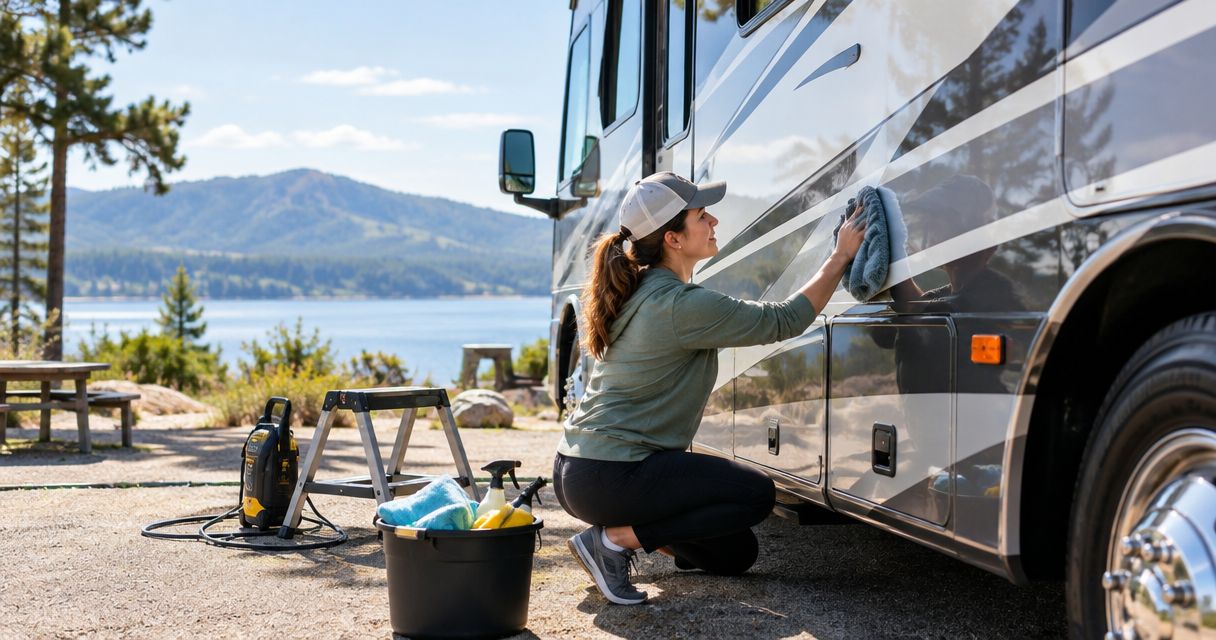
Full-time RV owners’ detailing is surface-specific cleaning and protection aimed at keeping a working home comfortable, presentable, and easier to maintain. Royal Touch Mobile Detailing LLC brings a faith-driven commitment to doing work right the first time; this 2026 guide explains how to plan that care around your campsite, travel schedule, and RV’s materials.
- Royal Touch Mobile Detailing LLC suits owners seeking mobile RV detailing within its stated service area.
- RV detailing for full-time RV owners starts with surface identification, campground permission, and a workable maintenance plan.
- Choose ceramic coating only after checking surface compatibility, preparation needs, and aftercare requirements.
- Detailing cleans and protects surfaces; it does not replace roof, seal, or water-intrusion repairs.
Why RV detailing matters for full-time RV owners
Your RV is both transportation and living space. Cleaning it affects where you cook, sleep, store belongings, and spend your downtime—not just how it looks when parked.
Full-time use also changes the practical job. You need access to essential belongings, somewhere for pets to stay, permission to wash at your location, and enough time for cleaned materials to dry before normal use resumes.
Royal Touch Mobile Detailing LLC is best suited to RV owners seeking mobile detailing in North Carolina and the parts of Virginia and South Carolina it serves. Confirm your specific location before arranging service through Royal Touch Mobile Detailing LLC.
For your 2026 care plan, separate appearance work from repair work. Washing helps expose damaged sealant, lifting graphics, or suspicious staining, but a detail is not a leak inspection or a repair. Address those concerns with the appropriate RV service professional before asking someone to polish or protect the surrounding area.
The goal is practical: preserve usable surfaces, keep your home comfortable, and avoid paying for work that does not address the actual problem.
Build your RV detailing plan in 6 steps
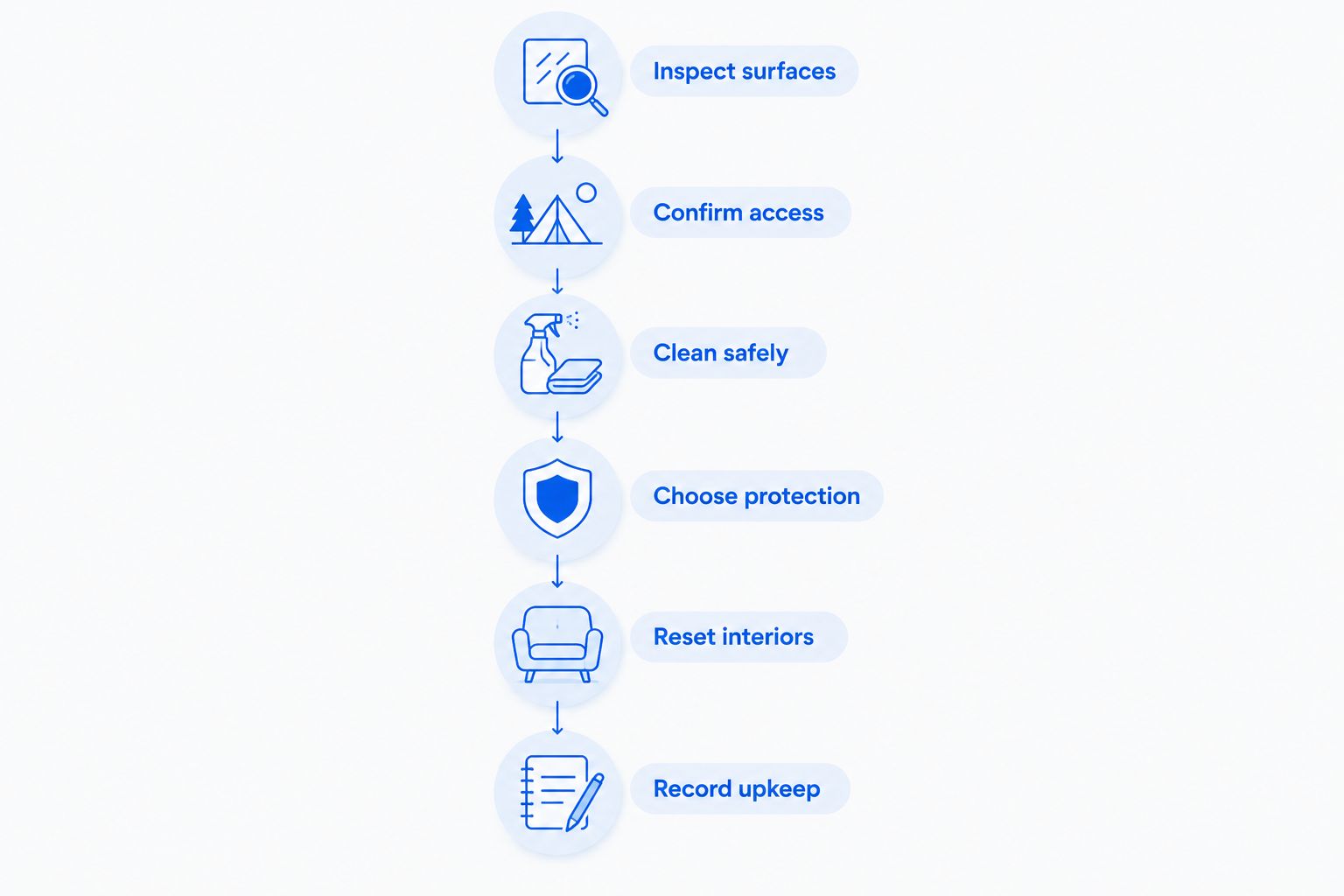
Start with your owner’s manuals, a walk-around, and a written list of concerns. Those steps require no detailing appointment and help you explain the job clearly. Follow this sequence: inspect surfaces, confirm access, clean safely, choose protection, reset interiors, and record upkeep.
Inspect surfaces
Walk around your RV before selecting a treatment. Painted panels, exposed gelcoat, graphics, roof membranes, plastic trim, and window materials do not all call for the same cleaner or polishing method. Your RV’s documentation is the starting point, not a product’s promise to clean everything.
Take 3 photos of each concern: an overall view, a closer view, and a detail showing its location beside a recognizable feature. This gives a detailer useful context without asking you to diagnose the damage yourself.
Check the roof from a safe position. Do not climb onto it simply to complete a cleaning checklist; roof access and load limits depend on the RV manufacturer’s instructions.
Separate removable contamination from damaged material. A dark streak, cloudy finish, and lifting decal need different responses, even when they appear on the same wall.
- Identify painted panels, gelcoat, graphics, and roof material.
- Photograph stains, dull patches, scratches, and lifting edges.
- Note existing coatings or protectants when known.
- Flag soft areas, loose trim, and suspected leaks for repair assessment.
Confirm access
Ask the campground or property manager what detailing work is allowed. Permission to park does not automatically include permission to wash, discharge wastewater, use shared utilities, or occupy neighboring space with equipment.
You can handle this yourself with a short message describing the proposed work. Get a clear answer before setting an appointment, and pass any restrictions to the detailer rather than assuming they already know the property.
For a 2026 travel schedule, choose a stop where the RV can remain accessible for the agreed work and aftercare. Explain whether you need continuous access to the entry door, kitchen, bathroom, or electrical hookups. Convenience depends on those details being settled beforehand.
Keep 2 checklists: one for property permission and another for the service scope. That separates location problems from cleaning decisions and makes rescheduling less confusing.
- Confirm washing and wastewater rules with the property manager.
- Ask what water and electricity the detailer needs.
- Discuss clearance around slides, awnings, doors, and hookups.
- Share your departure date and essential access needs.
- Arrange a separate place for pets during the work.
Clean safely
For routine upkeep, follow the RV and surface manufacturers’ cleaning directions. Work on manageable areas, keep cleaning tools free of grit, and avoid letting cleaning solution dry on the surface. Stop when a material reacts unexpectedly rather than trying a stronger product immediately.
A familiar automotive method is not automatically suitable for every RV surface. Roof membranes, graphics, clear plastics, and interior fabrics need their own instructions. Pressure washing also requires care around seams, vents, seals, and damaged areas; do not direct forceful spray into openings.
Professional help becomes useful when access, surface condition, or the size of the job exceeds what you can safely manage. Royal Touch Mobile Detailing LLC offers RV detailing; discuss the actual materials and concerns before agreeing to the work, especially where deterioration or previous repairs are visible.
- Use cleaners approved for the material being cleaned.
- Keep wheel and heavily soiled tools separate from finish-care tools.
- Test an unfamiliar method in an inconspicuous area.
- Avoid scrubbing loose graphics or damaged sealant.
- Stop cleaning if you find active water intrusion or unstable material.
Choose protection
Start with a clean, assessed surface rather than choosing protection by name alone. Wax, sealant, and ceramic coating are not substitutes for removing contamination or dealing with damaged finishes. A coating also does not repair cracked sealant, peeling graphics, or deep scratches.
For your 2026 protection decision, ask what material will receive the treatment, what preparation it needs, and how you must care for it afterward. Get instructions for washing and exposure before scheduling travel immediately after application. Follow the actual product’s directions instead of a universal waiting period.
The guide to ceramic coating for RV owners provides a focused next read if you are considering that service. The decision should follow the condition assessment, not precede it.
Choose the protection you can maintain, not the one with the strongest sales description.
- Match protection to the identified surface.
- Ask whether oxidation or other defects need attention first.
- Confirm compatibility around graphics and repaired areas.
- Request written washing and aftercare instructions.
- Leave room in your travel plans for the stated application requirements.
Reset interiors
Begin by removing loose belongings, vacuuming accessible areas, and identifying the material behind each stain. A carpet spot, coated seating surface, and unfinished wood panel should not receive the same treatment simply because they share a cabin.
Full-time living makes moisture management especially important. Do not put bedding, cushions, or stored items back against damp surfaces. Ventilate as directed and allow cleaned materials to dry before returning them to normal use.
Interior detailing is not a substitute for investigating persistent dampness, visible mold, plumbing leaks, or sewage-related odors. Find and address the source rather than covering it with fragrance. Explain where an odor occurs and when you notice it; that is more useful than asking for the strongest deodorizer.
Keep essential medication, documents, valuables, and pet supplies with you so they remain accessible throughout the appointment.
- Clear work areas without blocking exits.
- Identify fabric, vinyl, leather, and hard-surface care instructions.
- Point out stains and previous cleaning attempts.
- Agree on which storage spaces are included.
- Keep cleaned areas uncovered until they are fully dry.
Record upkeep
Create a maintenance note on your phone or in your RV records. Record the date, surfaces treated, products used when known, unresolved concerns, and the aftercare instructions. This helps the next person avoid guessing what is already on the finish.
For the rest of 2026, tie inspections to events as well as dates: a long travel leg, heavy tree fallout, a dusty stay, or visible buildup. There is no single detailing interval that fits every full-time owner’s route, storage conditions, and cleaning access.
Use your walk-around to decide whether the next task is a light clean, deeper detailing, or repair assessment. Do not keep polishing a deteriorating area simply because polishing helped somewhere else.
A useful maintenance record also protects your time: you can send the relevant history before an appointment instead of reconstructing it during the visit.
- Record treatment dates and aftercare directions.
- Save before-and-after photos taken in similar lighting.
- Check high-soil areas after travel.
- Track recurring stains or dampness separately from cosmetic concerns.
- Reassess the plan when your route or parking conditions change.
Compare RV detailing approaches
Match the approach to the problem and your ability to maintain the result. These are service categories, not named packages or promises of results. Confirm the actual scope before booking.
| Option | Best for | Practical advantage | Key limitation |
|---|---|---|---|
| Owner-managed maintenance | Full-time owners with approved washing access and suitable tools | Gives you direct control over routine cleaning | Requires time, safe access, and material knowledge |
| Professional mobile RV detailing | Owners seeking help where their RV is parked | Avoids moving the RV solely for an appointment when the location is suitable | Depends on service coverage, property permission, and working conditions |
| Surface correction before protection | Owners with suitable finishes showing oxidation or cosmetic defects | Addresses finish condition before a protective treatment | Not appropriate for every material or every defect; requires assessment |
| Ceramic coating service | Owners seeking a protective surface treatment with a defined care routine | Adds protection to compatible, properly prepared surfaces | Requires preparation and aftercare; does not eliminate washing or repairs |
If the RV is already clean and the finish is sound, a correction service should not be an automatic addition. Ask what specific defect the proposed work addresses. Equally, do not expect a basic wash to produce the same outcome as assessed restoration work.
Plan your RV detailing
Discuss your location, RV surfaces, travel schedule, and the work you need.
Common mistakes full-time RV owners make
Booking before asking the campground
A suitable parking space is not necessarily an approved wash site. Confirm the property’s rules first, then share them with the detailer. This avoids building your travel day around work the property will not permit.
Treating the whole RV as painted metal
An RV brings several materials together in a small area. Identify the surface before applying cleaner, polish, or protection, and do not assume a method suitable for the tow vehicle is suitable for the roof or graphics.
Buying protection before addressing deterioration
A protective treatment cannot make loose graphics, damaged seals, or unstable finishes sound again. Ask whether the surface needs repair, cleaning, or correction before discussing what goes over it. Repair needs take priority over appearance upgrades.
Planning interior cleaning without a drying plan
Your seating and bedding are part of your home, not spare furnishings. Discuss drying requirements before agreeing to wet cleaning, and plan where you will sit or sleep while treated materials remain out of use.
Leaving immediately after treatment without instructions
Departure plans need to account for the specific treatment’s aftercare. Ask about washing, weather exposure, and normal use before confirming the appointment. Do not substitute a generic online timeline for the instructions supplied for the product actually applied.
FAQ
What is the best RV detailing approach when I live in my RV full time?
The best approach combines manufacturer-approved routine cleaning with professional help for work you cannot safely or practically manage. Plan around your RV’s materials, campground rules, living-space access, and travel schedule.
Can a mobile detailer work at my campsite?
Campsite detailing requires property permission and suitable working conditions. Ask the campground about washing, wastewater, utilities, and equipment space, then confirm those conditions with the detailer.
How often should I detail my RV if I travel year-round?
Set your detailing schedule from surface condition, exposure, and manufacturer guidance rather than a universal interval. Inspect after travel and address contamination or new concerns before they become part of the next maintenance job.
Is ceramic coating better than regular washing for a full-time RV?
Ceramic coating does not replace regular washing. It is a protective treatment for compatible surfaces, while washing removes contamination; preparation and ongoing care remain necessary.
Can RV detailing fix oxidation and peeling graphics?
Oxidation requires a surface assessment, while peeling graphics require attention beyond routine cleaning. Correction methods depend on the underlying material and condition, and detailing cannot promise to restore damaged graphics.
Do I need to leave my RV during interior detailing?
Agree on occupancy and access before the appointment. The work area, cleaning method, drying requirements, and your need for essential facilities determine whether remaining inside is practical.
Does Royal Touch Mobile Detailing LLC travel everywhere in the Carolinas?
Royal Touch Mobile Detailing LLC serves North Carolina and parts of Virginia and South Carolina, not every location across those states. Confirm your campsite or property location before making travel plans around an appointment.
One last thing
Photograph the upper edges, not just the shiny sidewalls. From a safe ground-level position, record visible streak sources, graphic edges, trim, and areas beneath roof fixtures. Share anything you cannot see safely rather than climbing for a better photo.
For your next 2026 appointment, send those pictures with your surface list and property restrictions. A clear description of the RV’s condition is more useful than asking for the biggest package—and it keeps the conversation focused on the work your home actually needs.