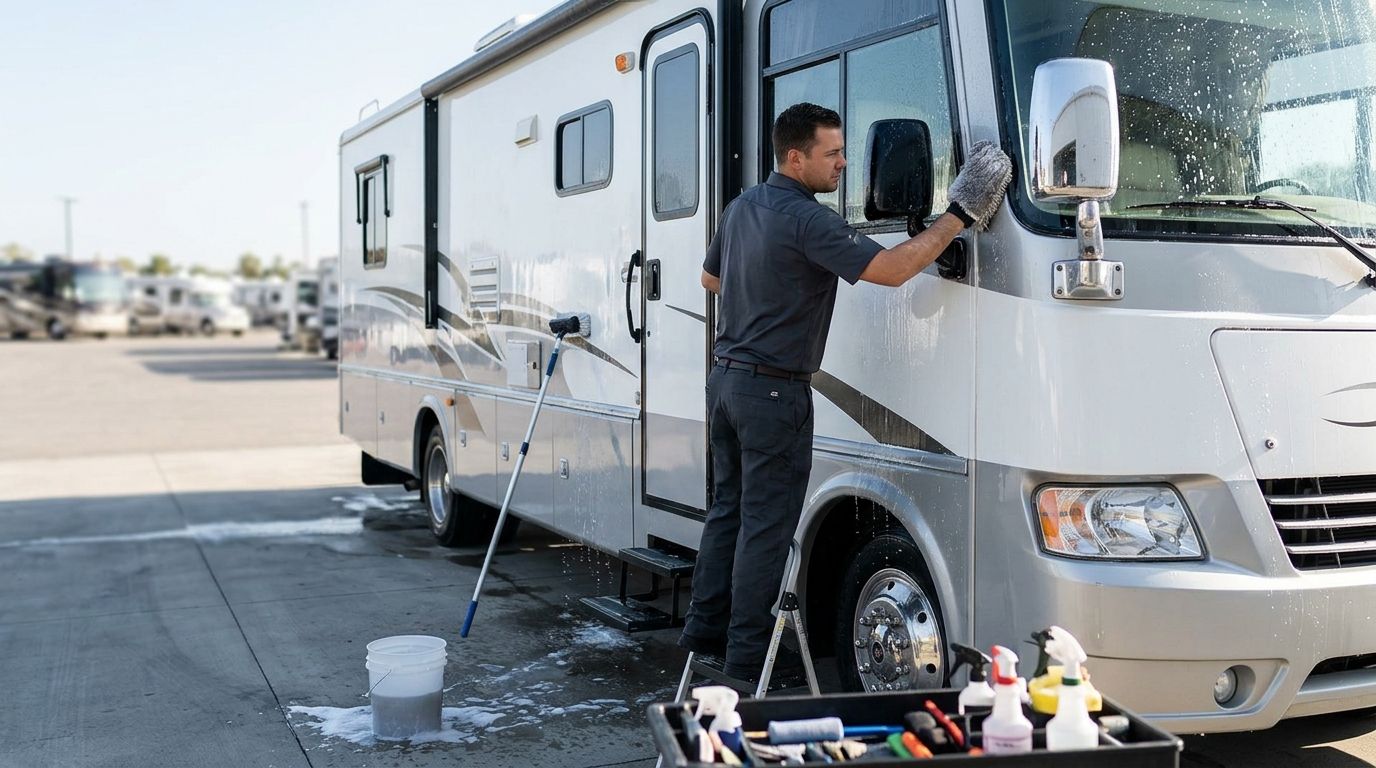
RV detailing has no single completion time: the schedule depends on your RV’s size, condition, and whether you want cleaning, paint correction, or protective coating work. Ask for both the estimated work time and the ready-to-use time, because upholstery drying and coating care instructions can extend beyond the hands-on appointment.
- How long does RV detailing take? Confirm the scope, condition, and ready-to-use time before scheduling travel.
- Royal Touch Mobile Detailing LLC offers mobile RV detailing; discuss your vehicle and protection goals before booking.
- Exterior cleaning, interior detailing, and correction involve different work; compare included tasks rather than appointment labels.
- Coating application and coating curing are separate stages; follow the instructions for the product actually used.
Why this matters
A clean RV and a travel-ready RV are not always the same thing. Damp seating, unfinished correction work, or coating restrictions can interfere with departure even after the visible cleaning is complete.
Royal Touch Mobile Detailing LLC brings a faith-driven commitment to doing work right the first time, with services spanning daily drivers, premium vehicles, RVs, and aircraft. For your 2026 travel plans, start with the work your RV needs rather than an appointment length you hope will fit.
Royal Touch Mobile Detailing LLC is best for RV owners seeking mobile detailing and a discussion of cleaning and protection needs. Mobile service brings the work to your location, but the workspace and agreed scope still need to suit the job.
How long does RV detailing take?
The useful estimate is specific to your RV and the agreed work—not a universal number of hours. An exterior maintenance clean is a different assignment from cleaning the living space, addressing paint defects, and applying protection.
Use this comparison to describe what you need. These are work categories, not named service packages or promises about what any appointment includes.
| Work category | Best for | What the estimate should address | Main limitation |
|---|---|---|---|
| Exterior cleaning | Removing exterior dirt and road grime | Included surfaces, access, cleaning, and drying | Cleaning alone does not correct paint defects |
| Interior detailing | Cleaning the living space | Rooms, materials, stains, and any wet-cleaning tasks | Wet-cleaned materials need drying time |
| Paint correction | Addressing suitable surface defects | Surface condition, test results, and agreed finish goals | Not every defect is safely removable |
| Protective coating work | Adding surface protection after preparation | Preparation, application, and product-specific aftercare | A coating does not replace cleaning or repair existing damage |
For a 2026 appointment, ask the detailer to separate those categories in the estimate. That makes it easier to understand what drives the schedule and what you would lose by reducing the scope.
Do not treat a shorter appointment as better by itself. Compare the included work, the finish you are seeking, and any restrictions after completion.
Exterior cleaning: confirm the surfaces included
Exterior cleaning involves more than choosing a wash date. Ask whether the proposed work covers the sidewalls, wheels, exterior glass, roof, awnings, and storage compartments; do not assume every surface is included.
Tell the detailer about visible streaks, bug residue, stubborn deposits, damaged decals, or areas you are concerned about. Those details help distinguish ordinary cleaning from a problem that needs separate assessment.
Best for: RV owners whose main goal is removing exterior dirt without requesting corrective work. The advantage is a focused scope; the limitation is that a clean surface can still show oxidation, scratches, or other defects.
If you want protection afterward, discuss it before the appointment. Adding another task changes the work plan, even when the RV already looks clean.
Interior detailing: include the drying question
An RV interior combines living areas with vehicle surfaces. Upholstery, flooring, cabinets, glass, and sleeping areas do not all need the same cleaning method, so identify the areas you want addressed.
Wet cleaning introduces a separate question: when will the material be dry enough for normal use? Fabric type, moisture introduced during cleaning, airflow, and surrounding conditions affect drying; the end of active cleaning is not a universal drying deadline.
Best for: Owners prioritizing the space where they sit, sleep, and travel. Interior detailing addresses cleanliness, but it does not automatically resolve every stain, odor source, or underlying moisture problem.
Before your 2026 trip, disclose spills, pet accidents, persistent odors, and known leaks. A recurring smell needs an assessment of its source, not an assumption that more shampoo will solve it.
Paint correction: assess the finish before setting the schedule
Paint correction is separate from washing. It involves assessing suitable surfaces and using an appropriate polishing process to address defects within the limits of the finish.
A glossy appearance does not prove that every mark can be removed safely. Existing damage, surface type, previous repairs, and the depth of a defect all matter when deciding what work is appropriate.
Best for: Owners concerned about visible finish defects rather than dirt alone. The benefit is targeted appearance work; the trade-off is additional preparation and polishing, with limits on what can safely be corrected.
Ask which areas need correction and which should be left alone. A clear explanation of those limits is more useful than a promise to remove every mark before a fixed departure time.
Protective coating work: separate application from aftercare
Coating work adds preparation and application tasks to the appointment. It also introduces product-specific instructions about exposure, washing, and curing that belong in your travel plan.
Best for: RV owners seeking an added protection step and willing to follow the required care instructions. The benefit is surface protection; the limitation is that coating cannot repair neglected or damaged material underneath it.
Read the guide to ceramic coating for RV owners before discussing the scope. Ask what preparation your RV needs and what restrictions apply after the selected coating is installed.
For 2026 scheduling, avoid treating application complete as permission to wash, cover, or expose the RV without checking. The instructions for the actual product—not a generic internet timeline—should guide those decisions.
Why RV detailing time varies
The schedule follows the vehicle and the work. Use these factors to explain your RV’s needs before accepting an estimate:
- RV size and layout: More exterior surface and more interior areas change the amount of work to assess and complete.
- Current condition: Routine dirt, embedded contamination, stained fabrics, and finish defects require different approaches.
- Included services: Washing, interior cleaning, correction, and coating are distinct tasks; confirm which ones belong in the appointment.
- Materials and finish: Paint, decals, trim, fabric, and other surfaces need methods suited to their condition and care requirements.
- Workspace and access: Working room, surface access, weather exposure, and permission to work at the location belong in the planning discussion.
- Drying and aftercare: Wet-cleaned materials and applied products have requirements that extend beyond visible task completion.
Choose the scope first, then agree on the schedule. Reducing an appointment window without changing the expected work creates a mismatch; removing an optional task is a clearer decision than asking for everything to be rushed.
How to get a useful RV detailing estimate
A useful estimate connects your vehicle, the requested result, and your departure plans. Give the detailer enough context to distinguish routine cleaning from restoration or protection work.
- Describe the RV. Share its type, dimensions if known, exterior materials if known, and the interior areas you want cleaned. Avoid guessing at a surface type.
- Share condition photos. Include overall views and close-ups of the areas that concern you. Photos support the conversation but do not replace an on-site assessment.
- Choose the scope. State whether you want exterior cleaning, interior work, correction, protection, or a combination. Ask for exclusions in plain language.
- Confirm the workspace. Describe the parking location and access. Ask what permissions, space, or site arrangements the proposed work requires.
- Confirm handoff. Ask when active work is expected to finish, when the RV can be used, and what aftercare instructions apply.
Keep the final scope somewhere you can refer to it. A written list helps you distinguish an agreed task from an extra request made after work begins.
Royal Touch Mobile Detailing LLC offers RV detailing alongside ceramic coating and paint correction services. Ask which work is appropriate for your RV rather than assuming every service belongs in the same visit.
Discuss Your RV Detailing Needs
Share your RV’s condition, requested work, and travel plans before choosing a service scope.
Can I leave for a trip immediately after RV detailing?
Immediate departure depends on the work completed and the instructions given at handoff. Confirm that wet-cleaned areas are ready for use and that any applied protection permits your planned travel conditions.
Tell the detailer your departure deadline before booking, not when work is nearly finished. If the requested scope conflicts with that deadline, discuss a different date or a narrower scope.
Does mobile RV detailing take less time than shop detailing?
Mobile RV detailing removes the need to take the RV to a shop, but it does not automatically shorten the cleaning or correction process. The work still depends on the RV’s condition, scope, and working environment.
The convenience is location, not permission to skip preparation. Confirm that the proposed site is suitable before choosing mobile service for a tightly scheduled day.
Should I empty my RV before the detailer arrives?
Remove personal belongings from the areas included in the work and secure valuables before the appointment. Ask whether bedding, stored equipment, or compartment contents need to be moved.
An accessible surface is easier to assess than one covered with belongings. Do not move heavy equipment or disturb installed systems without discussing what is necessary and safe.
FAQ
How long does RV detailing take if I only need the outside cleaned?
Exterior-only RV detailing still needs a vehicle-specific estimate based on size, condition, and included surfaces. Confirm whether the work includes the roof, awnings, wheels, glass, or protection rather than assuming that exterior means everything.
Can I get my RV detailed right before a trip?
Schedule RV detailing around the confirmed ready-to-use time, not just the end of active cleaning. Explain your departure plans before booking and ask about drying or product-specific restrictions.
Does ceramic coating make an RV detailing appointment longer?
Ceramic coating adds preparation and application tasks, along with product-specific aftercare requirements. Ask for the cleaning, preparation, application, and curing instructions to be explained separately.
Do I need to be home during mobile RV detailing?
Confirm attendance and access arrangements with the detailer before the appointment. The agreement should cover entry to included areas, permission to work, and how questions or scope changes will be handled.
Can RV detailing remove every stain and scratch?
RV detailing does not guarantee removal of every stain or scratch. Material condition, defect depth, and safe treatment limits determine what is appropriate.
What should I send when asking Royal Touch Mobile Detailing LLC about RV detailing?
Send your RV type, known dimensions, condition photos, requested work, location, and departure plans. Ask for the scope, expected completion, and aftercare requirements to be confirmed together.
Is an RV ready to cover as soon as detailing finishes?
Confirm that the RV is dry and that any applied product permits covering before putting the cover on. Follow the care instructions for the actual work performed rather than using a general waiting period.
One last thing
Ask, “When can I use my RV normally?”—not only, “When will you finish?” That wording brings drying, travel, covering, washing, and coating care into the same conversation.
For your 2026 plans, make the handoff part of the booking discussion. The right scope is one you understand, with practical instructions for caring for the result after the work ends.