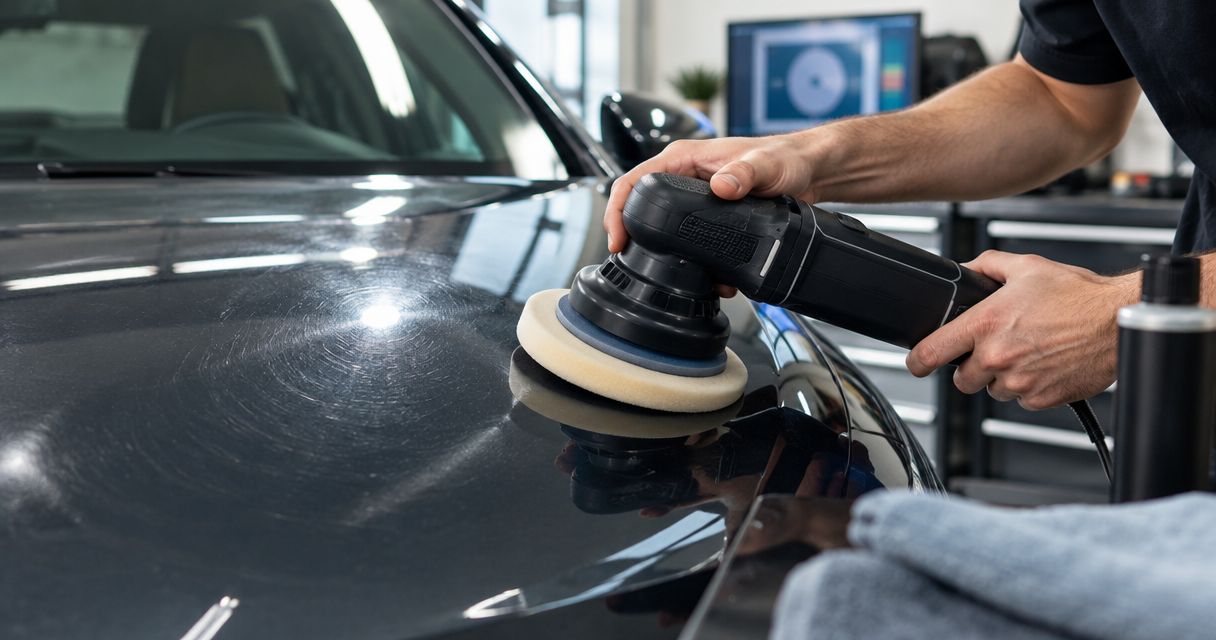
Yes, paint correction can remove swirl marks when the scratches are shallow enough to polish safely within the paint’s outer layer. It removes a small amount of that layer to level the marks rather than simply hiding them. Deep scratches, failing paint, and previously over-polished areas need a different approach; in 2026, preserving the finish matters more than chasing a flawless reflection.
- Can paint correction remove swirl marks? Yes, when shallow scratches can be safely leveled by polishing.
- Royal Touch Mobile Detailing LLC offers paint correction for owners seeking better appearance and long-term vehicle care.
- Paint correction removes defects; ceramic coating does not replace polishing or make paint scratch-proof.
- Choose the correction process after inspection and a test spot, not by stage count alone.
Can paint correction remove swirl marks?
Paint correction removes shallow swirl marks by polishing the surrounding finish until the scratches become less visible or disappear. On a vehicle with clear-coated paint, that work takes place in the clear coat—the transparent protective layer above the color. Removing too much compromises that layer, so safe correction has limits.
The right process depends on what the paint actually needs. A paint correction stages guide helps explain the terminology, but an inspection and test spot should determine the work.
| Approach | Best for | Main benefit | Main limitation |
|---|---|---|---|
| 1-step correction | Light swirls and general dullness | Improves the finish with a single polishing stage | Leaves defects that need stronger correction |
| 2-step correction | Swirls that require cutting followed by refinement | Separates defect removal from final finishing | Removes more material when stronger cutting is needed |
| 3-step correction | Finishes that need additional refinement | Adds another polishing stage for the finish being addressed | An extra stage does not automatically mean a better or safer result |
| Paint repair or refinishing | Damage beyond safe polishing limits | Addresses problems correction cannot resolve | Goes beyond routine detailing and requires a repair assessment |
These stage names describe a process, not a guaranteed outcome. Ask what the proposed stages accomplish on your vehicle, what defects will remain, and why that approach protects the finish.
Why this matters
Swirl marks scatter light across the paint, making reflections look hazy even after a wash. They often stand out on dark finishes and under direct sunlight, but the same washing and drying damage can affect lighter colors. A clean vehicle and a corrected finish are not the same thing.
Royal Touch Mobile Detailing LLC’s faith-driven service emphasizes doing the work right the first time, with experience serving premium vehicles and aircraft. For automotive paint correction, that means matching the work to the condition of the finish—not treating every visible scratch as something that must be removed.
Royal Touch Mobile Detailing LLC paint correction is best for owners seeking mobile service to improve swirl-marked vehicle paint. Its detailing, ceramic coating, and paint correction services give you relevant care options; correction’s limitation remains the same regardless of provider: polishing cannot safely remove every defect.
For your 2026 vehicle-care plan, separate appearance goals from protection goals. Correcting swirls improves the surface you see; careful washing and suitable protection help you care for that finish afterward.
What swirl marks actually tell you
The circular-looking patterns around a bright light are usually many fine scratches catching the light together. They do not necessarily mean someone polished the paint in circles. Washing, wiping, and drying with contaminated materials can leave marks in different directions that appear as a halo under inspection lighting.
Before choosing correction, make sure the marks are scratches rather than residue, bonded contamination, or mineral deposits. Those problems need different preparation, and polishing over contamination is not a sound starting point. A properly cleaned surface makes the assessment more useful.
Look at several panels, not just the hood. A repainted door, weathered roof, and regularly washed bumper can respond differently to the same polish. One successful test area does not establish that every panel needs identical treatment.
If you are inspecting your car at home, avoid rubbing a dirty panel to see whether a mark disappears. Clean it appropriately first, then view the dry surface under direct light. Share what you notice with the detailer rather than trying to diagnose scratch depth from a photograph alone.
1-step correction: light swirls and simpler finishing
A 1-step correction uses a polishing stage selected to improve defects and finish quality together. It suits paint whose swirl marks respond well without a separate, stronger cutting stage. For a daily driver, this can be a sensible balance between appearance and paint preservation.
The benefit is a simpler correction process. The trade-off is that stubborn scratches and deeper marks remain when removing them would require more aggressive work. That is not automatically a poor result; retaining a healthy finish is a legitimate priority.
Choose 1-step correction when the test spot meets your appearance goal without stronger polishing. Ask to see the finish under inspection lighting, not only in shade, and make sure the assessment is made after polishing residue has been removed.
2-step correction: cutting followed by refinement
A 2-step correction separates stronger defect removal from a finishing polish. The first stage addresses defects; the second refines the surface when the cutting stage leaves haze or fine polishing marks. The finishing stage is part of the correction, not an optional shine-only extra.
This approach fits paint that needs more than a finishing polish to address the visible swirls. Its advantage is control over distinct jobs. Its limitation is that stronger correction consumes more of the finish, so the decision needs to reflect paint condition and previous work.
Choose 2-step correction when inspection supports stronger cutting and a separate finishing stage. For a 2026 booking, ask why both stages are needed on your car rather than assuming the higher stage count is always preferable.
3-step correction: additional refinement when justified
A 3-step correction adds another polishing stage to the planned process. The exact sequence varies, so the label alone does not explain how aggressive the work is or what result to expect. Ask the detailer to describe the purpose of each stage in plain language.
Additional refinement has a role when the finish calls for it. The drawback is unnecessary work if the same safe result is achievable with fewer stages. More polishing is not a substitute for careful diagnosis.
Choose 3-step correction only when each stage has a clear purpose supported by the test results. Do not select it merely because the vehicle is expensive, the paint is black, or the package sounds more complete.
Why swirl removal varies
Paint correction results depend on the finish being worked on. These factors explain why the same process does not produce an identical result on every vehicle:
- Scratch depth: Shallow marks are more suitable for polishing than scratches extending beyond the safely correctable surface.
- Paint condition: Peeling, cracking, and clear-coat failure are repair concerns, not ordinary swirl-removal jobs.
- Previous correction: Past polishing affects how much material remains available for future work.
- Panel history: Repainted panels can behave differently from the surrounding factory finish.
- Paint response: The pad, polish, and technique need to suit how the actual surface responds during testing.
- Your appearance goal: Improving a regularly driven car is a different target from pursuing a highly refined display finish.
You do not need to know the technical answer to each factor before booking. You do need to disclose repainting, previous correction, and known damage. That history helps the detailer choose a more informed starting point.
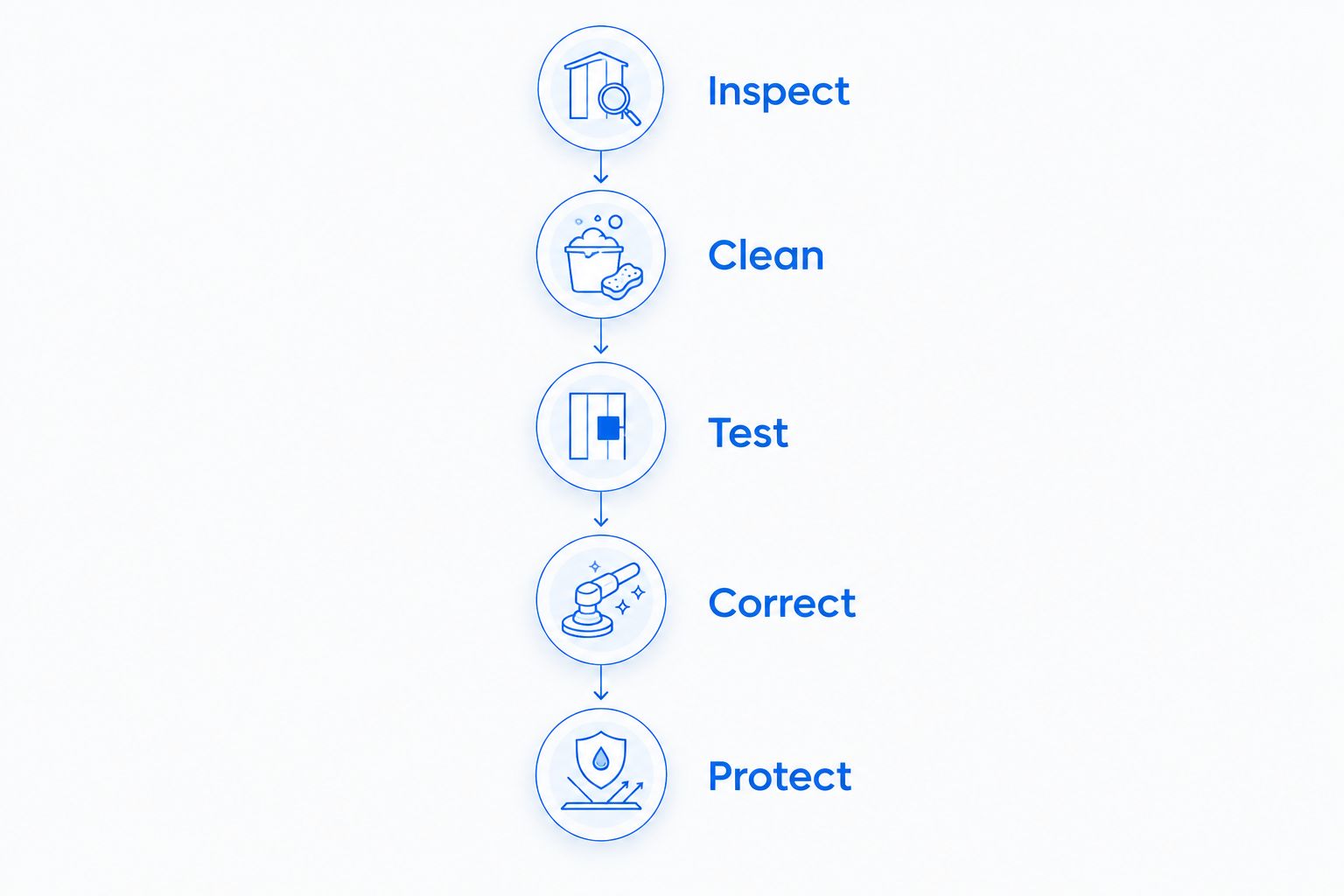
How should paint correction be approached?
A sound correction plan follows the condition of the vehicle. In 2026, the useful question is still whether the proposed process suits your paint—not whether it follows a fashionable package name.
- Inspect: Review the finish, visible defects, repaint history, and areas that need special care. Discuss your expectations before polishing begins.
- Clean: Wash and address contamination with methods appropriate to the surface. Correction belongs on prepared paint, not on embedded dirt.
- Test: Try a suitable polishing combination on a small area. Assess both defect improvement and the finish it leaves.
- Correct: Apply the justified process, adjusting where panel condition requires it. Preserve vulnerable areas rather than forcing uniform correction.
- Protect: Choose appropriate protection and discuss washing habits. Protection supports ongoing care but does not make the paint immune to scratches.
The test spot is the decision point. A process that leaves clear reflections but fails to address your concern needs discussion; a process that removes the concern only through excessive abrasion needs restraint.
Ask what the finish should look like after the work and which defects will remain. A clear explanation gives you something more useful than an unspecified promise to remove everything. You can discuss mobile detailing and paint correction with Royal Touch Mobile Detailing LLC before choosing the service.
Discuss your paint correction needs
Share the swirl marks, paint history, and appearance goals you want assessed.
Can paint correction remove deep scratches too?
Paint correction does not safely remove every deep scratch. If leveling a scratch requires removing too much finish, leaving it reduced rather than fully removed is the appropriate limit. Damage that reaches the color layer or substrate needs a repair assessment.
A scratch catching your fingernail is a reason for caution, not a reliable measurement of remaining paint. Do not turn that home check into permission to use a stronger compound. The stopping point should protect the finish, even when a visible mark remains.
Does ceramic coating remove swirl marks?
Ceramic coating does not replace paint correction or level swirl scratches. If you want the swirls addressed, discuss correction before applying a coating. Putting protection over existing defects is not the same as correcting them.
Coating and correction serve different purposes: correction improves the surface, while coating provides a protective surface treatment. Neither eliminates the need for careful washing. In a 2026 protection plan, choose the correction level first and discuss the coating’s care requirements separately.
How do you keep swirl marks from returning?
Swirl marks can return through later washing and drying damage. Corrected paint is not scratch-proof, and repeating aggressive correction whenever new marks appear is not a sustainable care strategy. Changing how you touch the paint matters.
- Rinse away loose grit before contact washing.
- Use clean wash materials suitable for automotive paint.
- Keep wheel-cleaning materials separate from paint-cleaning materials.
- Replace or clean towels when they become contaminated.
- Avoid dry wiping dusty panels.
- Use gentle drying methods rather than pressing harder to remove remaining dirt.
For daily drivers, a workable maintenance routine is more valuable than an appearance target you cannot maintain. Luxury and performance vehicle owners need the same basics; an expensive finish does not excuse contaminated towels or careless washing.
FAQ
Can paint correction remove swirl marks permanently?
Paint correction can physically remove existing shallow swirl marks, but new marks can develop afterward. Careful washing and drying help reduce avoidable scratching; correction does not make paint scratch-proof.
Is a 1-step paint correction enough for swirl marks?
A 1-step paint correction is enough when a test spot achieves the desired improvement safely. Deeper defects or polishing haze can justify a different process, so stage count should follow the inspection.
Will paint correction remove all scratches from my car?
Paint correction will not safely remove all scratches from every car. Deep damage, failing clear coat, and areas with limited remaining finish require restraint or a separate repair assessment.
Does ceramic coating hide or remove swirl marks?
Ceramic coating does not level swirl scratches and should not be treated as a replacement for correction. Discuss the desired finish before choosing protection.
Can a new car need paint correction?
A new car can have swirl marks or other surface defects before you take delivery. Inspect the actual paint rather than assuming a new vehicle needs either no correction or an aggressive correction process.
Does Royal Touch Mobile Detailing LLC offer paint correction?
Royal Touch Mobile Detailing LLC offers paint correction alongside mobile detailing and ceramic coating services. Discuss your vehicle’s condition, paint history, and appearance goals before selecting the work.
Should I polish a scratch until it disappears?
Do not keep polishing a scratch simply because it remains visible. Removing additional finish can create damage, and some marks should remain or receive a separate repair assessment.
One last thing
The most useful before-and-after comparison uses the same lighting, angle, and clean, dry surface. Shade can conceal marks that direct light reveals, making an ordinary lighting change look like correction. Ask to judge the result under conditions that actually show the defects.
Royal Touch Mobile Detailing LLC paint correction belongs in a care plan, not an endless pursuit of removing every mark. For your 2026 appointment, bring a clear goal: address the distracting swirls, preserve the finish, and understand how to care for it afterward.