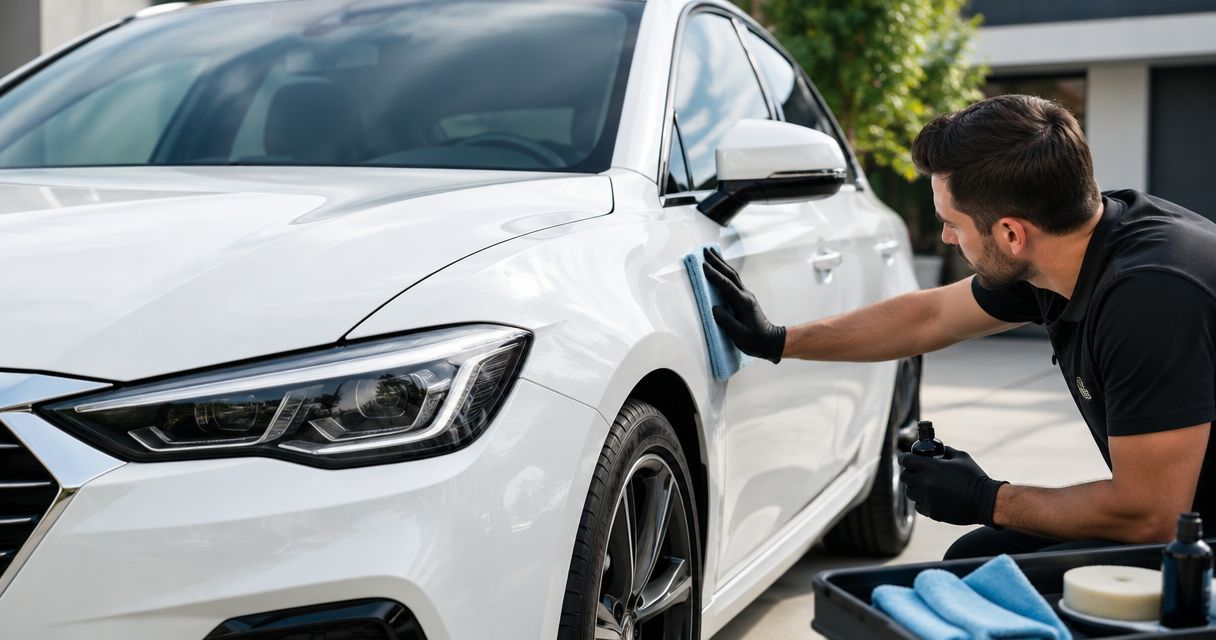
Best overall: professional ceramic coating on properly prepared paint. Best for swirl-marked white cars: paint correction followed by coating. Best for hands-on owners: a DIY ceramic coating. Best for maintenance: a ceramic spray used as directed. Royal Touch Mobile Detailing LLC brings faith-driven service, a commitment to doing work right the first time, and experience with premium vehicles and aircraft to the conversation about protecting your white car.
- Professional ceramic coating for white cars is the default choice when you want help with preparation and application.
- Royal Touch Mobile Detailing LLC offers ceramic coating and paint correction; choose the work your paint actually needs.
- White paint still needs inspection: bonded contamination, water spots, and uneven application can remain visible.
- DIY coatings suit careful owners; ceramic sprays serve a different role and should not be treated as equivalent protection.
Why this matters
White paint can hide fine swirl marks from some viewing angles, but it does not hide every problem. Road film, dark streaks, mineral deposits, and small rust-colored contamination spots can interrupt an otherwise clean finish.
The best ceramic coating for white cars starts with clean, sound paint—not a color-specific label. In 2026, choose your protection around the paint's condition, your washing habits, and the preparation included in the job.
For owners seeking mobile ceramic coating and paint correction, Royal Touch Mobile Detailing LLC serves North Carolina and parts of Virginia and South Carolina. Confirm your location and vehicle needs before arranging service.
What makes the best ceramic coating for white cars?
Use these criteria before choosing an approach. A coating's label cannot tell you whether the paint underneath is ready.
- Paint condition: Inspect for swirls, staining, oxidation, and previous repairs before deciding whether polishing belongs in the work.
- Surface preparation: Washing and appropriate contamination removal give you a clean starting point. Follow the coating manufacturer's preparation instructions.
- Application control: Suitable lighting helps reveal uneven coverage and residue that blends into white paint.
- Aftercare fit: Choose an approach you can maintain with careful washing and the specified curing instructions.
- Clear expectations: Ceramic coating does not replace washing, repair deep scratches, or provide stone-chip protection equivalent to protective film.
A professional application is not automatically the right answer for every owner. It earns its place when the inspection, preparation, application, and aftercare explanation address your actual vehicle.
Ceramic coating options at a glance
This 2026 ranking compares service and application approaches, not competing brands or unnamed service packages. Each option solves a different ownership problem.
| Rank and option | Best for | Standout feature | Key limitation |
|---|---|---|---|
| 1. Professional ceramic coating | Owners with sound paint who want application help | Preparation and application handled as a service | Scope and working conditions need confirmation |
| 2. Paint correction followed by coating | Owners unhappy with existing swirl marks or haze | Improves suitable paint defects before protection | Adds paint work that not every vehicle needs |
| 3. DIY ceramic coating | Careful owners with a suitable workspace | Direct control over preparation and application | Application errors become your responsibility |
| 4. Ceramic maintenance spray | Owners maintaining compatible existing protection | A maintenance step used according to its label | Not interchangeable with every standalone coating |
1. Professional ceramic coating: best for prepared daily drivers
Professional ceramic coating suits owners who want help preparing and protecting a white daily driver. The service should begin with an inspection, not an assumption that every vehicle needs extensive polishing.
Royal Touch Mobile Detailing LLC is a ceramic coating option for white-car owners who want mobile service in its stated service area. Ask what preparation the proposed work includes and how the application location will meet the selected coating's requirements.
Professional ceramic coating pros:
- Places preparation and application in the same service discussion.
- Gives you someone to ask about visible contamination and paint concerns.
- Fits owners who prefer not to handle coating application themselves.
Professional ceramic coating cons:
- The service description needs enough detail to distinguish cleaning from correction.
- Mobile work still requires suitable access, weather conditions, and workspace.
Best for: Daily drivers with sound paint whose owners want professional application rather than a DIY project.
Do not request extra polishing simply because the car is white. Ask the detailer to show you the defects that justify it, especially on previously repaired panels.
Verdict: Buy professional application when the preparation and aftercare plan match your car.
2. Paint correction followed by coating: best for visible swirls
Paint correction uses controlled polishing to improve suitable surface defects. Ceramic coating follows that work; it does not perform the correction itself.
Choose this approach when your white paint looks hazy under direct lighting or shows wash marks you want addressed. The guide to applying ceramic coating after paint correction explains the relationship between improving the finish and protecting it.
Paint correction followed by coating pros:
- Addresses suitable swirl marks before coating application.
- Lets you discuss appearance goals before protection is applied.
- Separates defect removal from the coating's protective role.
Paint correction followed by coating cons:
- Polishing removes some paint material and needs a restrained approach.
- Deep scratches, failed clear coat, and other damage can fall outside safe correction.
Best for: Used-car owners and appearance-focused owners with visible defects that an inspection identifies as suitable for correction.
For a luxury or performance vehicle, ask which marks should remain rather than be chased aggressively. Preserving the finish matters more than pursuing every isolated scratch.
Verdict: Buy correction before coating when visible, safely correctable defects bother you.
3. DIY ceramic coating: best for careful hands-on owners
A DIY ceramic coating gives you responsibility for the entire process, from cleaning to final inspection. White paint does not make that process foolproof; uneven residue can be difficult to spot without deliberate lighting checks.
In 2026, choose a DIY coating by its written application requirements and suitability for your workspace. Do not select one solely because the packaging emphasizes hardness, gloss, or an impressive durability claim.
DIY ceramic coating pros:
- Gives you direct control over each preparation step.
- Suits owners who enjoy careful, methodical vehicle care.
- Lets you inspect and work through the vehicle section by section.
DIY ceramic coating cons:
- Requires you to recognize contamination, paint defects, and application residue.
- Mistakes can require additional work, including polishing, to address.
Best for: Experienced home detailers with suitable lighting, shelter, supplies, and time to follow the manufacturer's instructions.
Read the complete instructions before opening the product. Check surface restrictions, working conditions, residue-removal guidance, and curing requirements rather than learning those details midway through a panel.
Verdict: Buy a DIY coating only if you can complete the preparation and application as directed.
4. Ceramic maintenance spray: best for compatible coating upkeep
A ceramic maintenance spray belongs in a different category from a full coating application. Depending on its formulation and instructions, it can serve as a maintenance product or a simpler standalone protectant.
Use the label to determine its role. The word ceramic does not establish that a spray and a professionally applied coating have identical preparation requirements, resistance, or service life.
Ceramic maintenance spray pros:
- Fits owners who want a protection-related maintenance step during routine care.
- Can support an existing coating when the products are compatible.
- Provides a separate option for owners not choosing a full coating application.
Ceramic maintenance spray cons:
- Cannot substitute for paint correction or contamination removal.
- Compatibility and use instructions vary by product.
Best for: Owners maintaining an existing coating with an approved product, or choosing a simpler protectant with clear expectations.
More product does not automatically mean better results. Follow the application amount and removal method on the label rather than layering spray onto unresolved dirt or residue.
Verdict: Buy for the stated maintenance role; skip it as an assumed replacement for every ceramic coating.
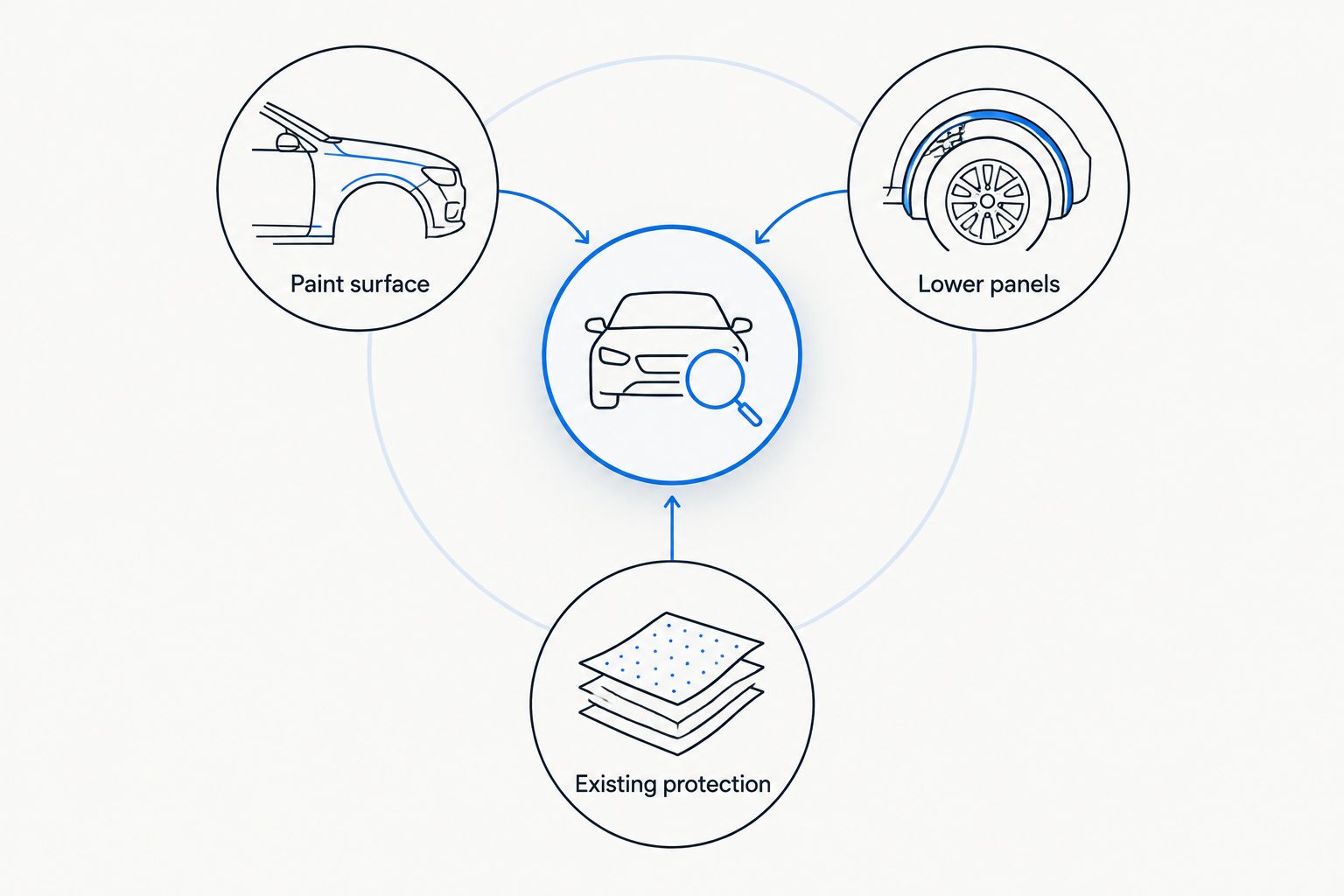
Inspect these 3 areas before choosing your approach
A useful inspection separates what needs cleaning from what needs paint work. Start with these 3 areas before discussing coating application in 2026.
Paint surface
Look across the hood, roof, and doors under different lighting. Note haze, scratches, mineral rings, and small colored specks; do not assume every mark needs polishing.
Lower panels
Check behind the wheels, along the rocker panels, and around the rear of the vehicle. These areas collect road contamination, and dark deposits stand out against white paint.
Existing protection
Tell the detailer about previous coatings, waxes, sealants, film, or repainting. Unknown previous work deserves discussion before another product goes on top.
You do not need to diagnose every speck yourself. Show the detailer where it appears, explain what you have already tried, and ask which cleaning or correction step addresses it.
Match maintenance to how your white car is used
The coating decision is only part of the ownership plan. A garage-kept weekend car and an outdoor daily driver face different exposure, so their care should reflect actual use rather than an identical calendar.
Deciding how often to schedule detailing starts with where the vehicle parks, what it encounters, and how quickly contamination returns. Those same factors help you decide when ordinary washing is enough and when the finish needs closer inspection.
For your 2026 maintenance plan, record what you see after washing: persistent lower-panel film, deposits that remain on the surface, or changes in how evenly water moves across a clean panel. These observations are more useful than judging the entire coating from a single water-beading video.
Do not treat every change in beading as proof that the coating has failed. Surface contamination and product residue can affect water behavior; inspect and clean appropriately before deciding that reapplication is necessary.
Use the coating's care instructions to choose wash products and methods. Avoid abrasive washing habits, and address bird droppings and other contamination promptly using a method appropriate for the surface.
Ask these 2 questions before booking
Royal Touch Mobile Detailing LLC offers ceramic coating, paint correction, and mobile detailing. Use the booking conversation to connect those services to your white car's condition rather than asking for an unnamed package.
- What preparation does my paint need? Ask whether the proposed work includes contamination removal, polishing, or both, and request an explanation of why.
- What must happen after application? Confirm curing restrictions, washing guidance, the required workspace, and what to do if the forecast changes.
Give the detailer a clear description of the vehicle's use, parking situation, previous protection, and visible defects. Mention recent bodywork so the coating plan can account for the refinisher's instructions.
For aircraft owners and operators, keep the conversation separate from automotive coating choices. A product suitable for a car is not automatically suitable for aircraft surfaces, transparencies, sensors, or other sensitive components.
Discuss your white car's protection
Ask about ceramic coating, paint preparation, and mobile service for your vehicle.
How these options rank
This ranking prioritizes paint condition, preparation, application control, maintenance fit, and honest limitations. It ranks approaches by ownership need, not by unpublished tests or assumed product performance.
Professional application is the default for owners who want help with the process. Correction comes first when appearance defects justify it; DIY application suits capable owners; maintenance sprays belong in the role their instructions describe.
Which ceramic coating approach should you choose?
Choose professional ceramic coating for a white car with sound paint, and add correction only when an inspection supports it. That is the clearest starting point for an undecided owner in 2026.
Choose DIY application when you want responsibility for the preparation and can meet the product's requirements. Choose a maintenance spray for compatible upkeep—not because every bottle carrying the word ceramic does the same job.
FAQ
What's the best ceramic coating for white cars?
Professional ceramic coating on properly prepared paint is the default choice for owners who want help with application. Add paint correction only when an inspection identifies suitable defects you want improved.
Does white paint need a special ceramic coating?
White paint does not inherently require a color-specific ceramic coating. Choose a product suitable for the actual surface and follow its preparation, application, and care instructions.
Will ceramic coating remove yellowing from my white car?
Ceramic coating is not a treatment for yellowing. Identify whether the discoloration comes from surface contamination, staining, or paint deterioration before choosing cleaning, correction, or repair.
Can ceramic coating stop scratches and rock chips?
Ceramic coating does not make paint scratch-proof or provide the same stone-chip protection as protective film. Careful washing and realistic expectations remain necessary.
Do I need paint correction before coating a new white car?
A new white car needs inspection before anyone decides whether correction is necessary. Newness alone does not establish that the finish is defect-free, and coating alone does not justify unnecessary polishing.
Is a ceramic spray the same as a professional coating?
A ceramic spray is not automatically equivalent to a professionally applied coating. Its intended use, preparation requirements, compatibility, and performance depend on the specific product.
Can I wash my white car immediately after ceramic coating?
Follow the coating manufacturer's curing and washing instructions rather than washing immediately by default. Ask your installer for the specific restrictions before the vehicle returns to regular use.
One last thing
Ask to inspect the finished white paint from more than one angle before calling the job complete. A finish that looks even head-on can reveal residue when viewed across the panel under different lighting.
Make inspection part of the handoff, not an afterthought. Pair it with written care instructions so you know how to look after the work once the appointment ends.