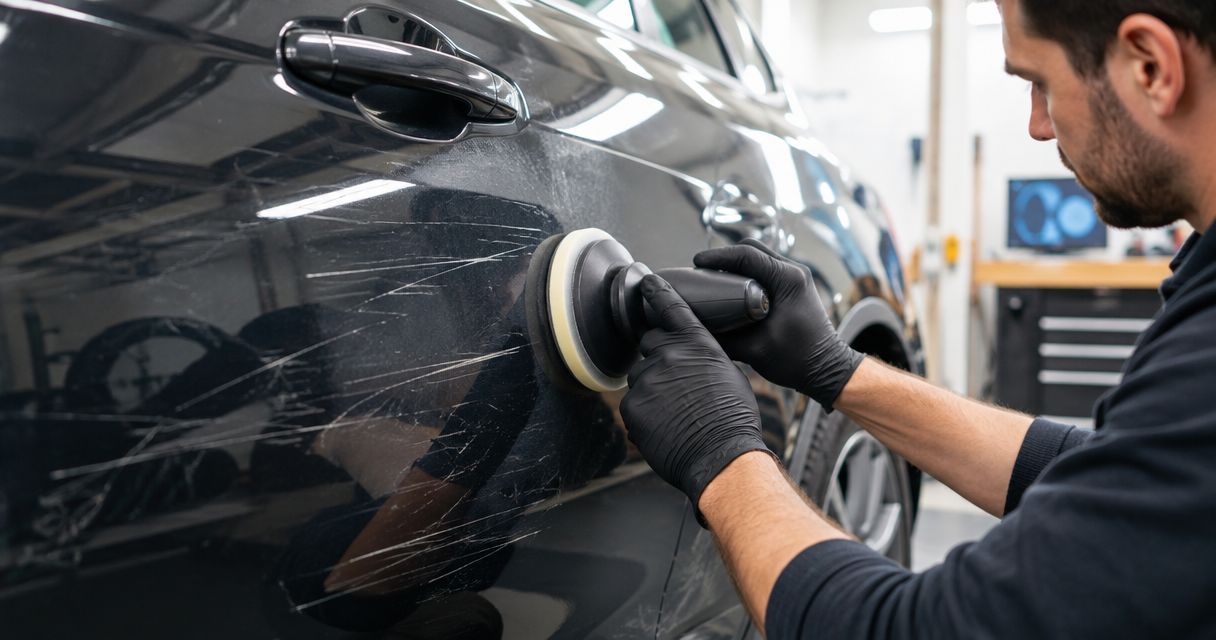
Paint correction can remove scratches contained within the clear coat when enough sound finish remains, but it cannot remove deep scratches that reach the color coat, primer, or bare metal. Polishing away those deeper marks would mean removing surrounding paint that your vehicle still needs. The right goal is better-looking paint without sacrificing the finish to chase one scratch.
- Can paint correction remove deep scratches? Only when the damage stays within safely correctable clear coat.
- Paint correction removes finish; it does not replace missing color or repair exposed metal.
- Royal Touch Mobile Detailing LLC offers paint correction for owners seeking improved appearance alongside mobile detailing.
- Choose scratch repair by damage depth, not by how many polishing stages a package includes.
Why this matters
Royal Touch Mobile Detailing LLC brings a faith-driven commitment to doing work right the first time, with services for premium vehicles and aircraft. For your daily driver or weekend car, that starts with understanding what correction can fix—and where paint repair belongs instead. The company's mobile detailing services include paint correction and ceramic coating.
In 2026, the decision is still about the condition of your finish, not the newest polishing product. A scratch-free appearance is not a good trade if achieving it leaves the surrounding paint unnecessarily thin.
You also need a clear distinction between removing a scratch and making it less noticeable. Smoothing the edges of a deep mark can improve its appearance while leaving the actual groove behind. That is a different outcome from complete removal, and your service discussion should make the difference plain.
Can paint correction remove deep scratches?
Paint correction removes a scratch by leveling the surrounding finish, not by filling the damaged area with new paint. On a typical clear-coated vehicle, the clear coat sits above the color coat. Correction works within that outer layer; damage below it calls for a different repair approach.
Appearance alone does not establish depth. A bright line might be a scratch, transferred material from another object, or a combination of both. Cleaning and inspection come before deciding whether to polish.
| Damage or condition | Best for | What correction can do | Main limitation |
|---|---|---|---|
| Light swirls and shallow clear-coat scratches | Owners seeking a cleaner reflection | Reduce or remove defects when the finish permits | Removes some clear coat rather than adding protection |
| Deeper scratches still within clear coat | Owners comfortable with improvement rather than guaranteed removal | Improve visibility; complete removal depends on remaining finish | Chasing the deepest point can remove too much surrounding finish |
| Scratches through the color coat | Owners needing missing color repaired | Improve nearby paint, not replace missing color | Requires evaluation for touch-up or refinishing |
| Scratches exposing primer or metal | Owners needing repair beyond detailing | Improve unaffected surrounding areas | Cannot rebuild missing paint layers |
| Surface paint transfer | Owners with material deposited on otherwise intact paint | Cleaning can reveal whether correction is needed | Removing transfer does not establish that the underlying paint is undamaged |
A scratch that remains after careful correction is not automatically a failed job. Sometimes leaving the deepest portion is the responsible stopping point. Ask what can be improved, what will remain, and what repair would address the remaining damage.
How to assess a scratch before choosing correction
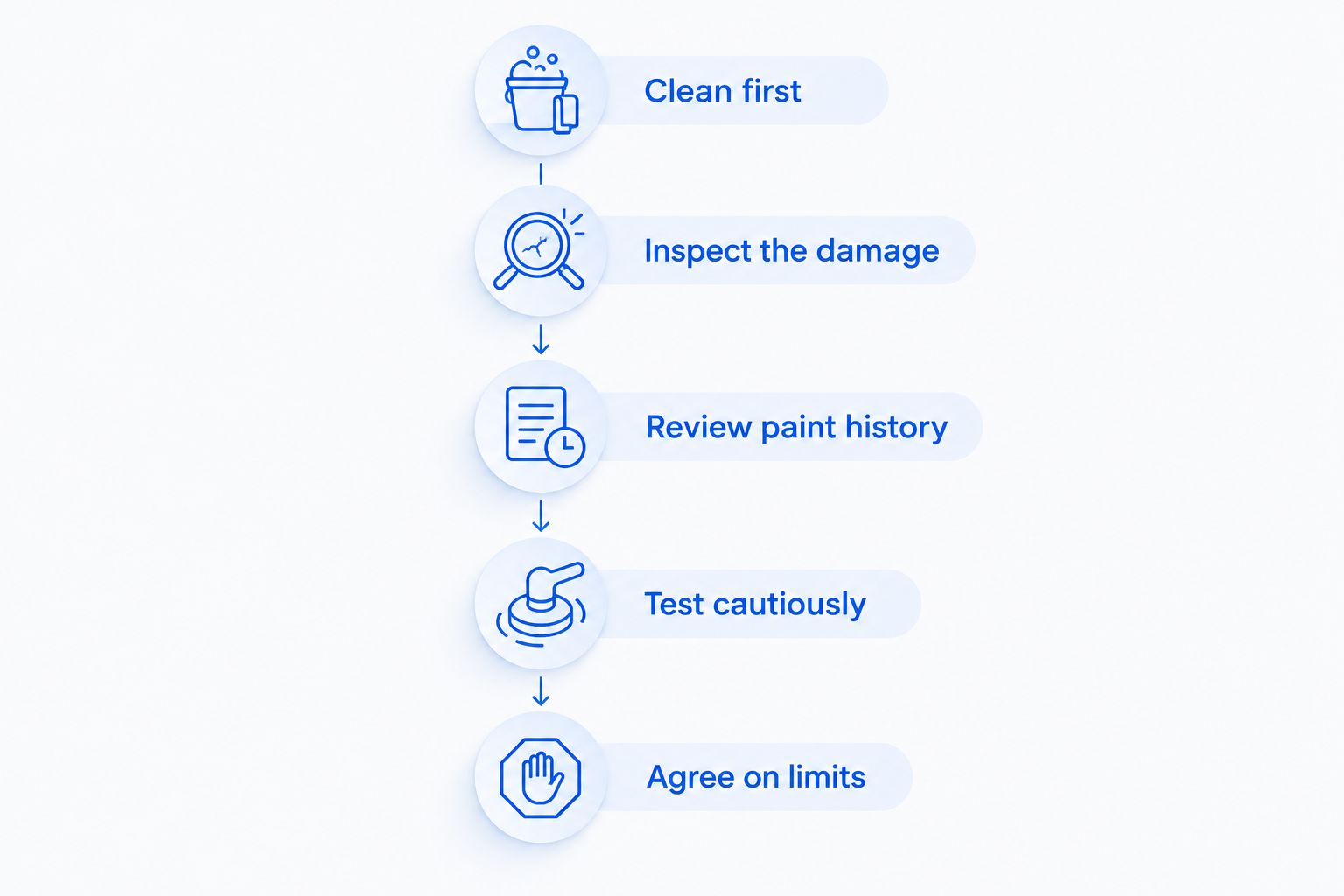
Use this process to organize the conversation with your detailer. It is an inspection checklist, not a recipe for aggressively polishing your own paint.
1. Clean first
Wash away loose dirt before inspecting or touching the damaged area. Rubbing a dirty panel makes it harder to judge the mark and risks introducing additional scratches.
Do not start with a harsh solvent or an abrasive household sponge. A mark that looks like missing paint can include material sitting on top of the finish. Identify what is present before trying to remove it.
2. Inspect the damage
Look at the area under different lighting and from different angles. Note whether the mark is a narrow groove, a broad scuff, a chipped edge, or visible exposed material.
A clean fingernail catching in a scratch is a warning that the mark has depth, not proof that it has reached a particular paint layer. Do not keep dragging your nail across it. Treat the result as a reason for closer inspection rather than a pass-or-fail test.
3. Review paint history
Tell the detailer about previous polishing, body repairs, repainted panels, and known damage. A vehicle's age alone does not explain how much workable finish remains.
Paint-thickness measurements can inform the assessment, but a standard total-thickness reading does not isolate clear-coat thickness. Readings also require suitable equipment for the panel material. A measurement is useful evidence, not automatic permission to keep polishing.
4. Test cautiously
A professional test area helps establish how the finish responds to an appropriate polishing approach. The goal is to find the least aggressive method that delivers an acceptable improvement.
Inspect the result after removing polishing residue. Residue can make defects harder to see, so evaluating only the freshly polished surface can give you the wrong impression of the result.
5. Agree on limits
Decide whether your priority is removing general swirls, reducing the scratch's visibility, or repairing missing paint. Those goals do not always require the same service.
For a 2026 appointment, ask for the intended outcome in plain language: removal, improvement, or referral for paint repair. An agreed stopping point is more useful than an open-ended request to keep polishing until the mark disappears.
1-step correction: a limited polishing approach
Best for: paint with lighter defects that responds well to a single polishing stage. A 1-step correction uses one polishing stage to improve the finish. Depending on the paint and process, that stage can address light swirls, haze, and some shallow scratches.
Its advantage is a simpler approach when the paint does not need separate cutting and finishing stages. Its limitation is that a single stage does not necessarily deliver both substantial defect removal and the finest possible finish on every paint system.
Do not interpret “1-step” as a specific scratch-depth rating. It describes the process, not the amount of clear coat available or a guaranteed level of removal.
2-step correction: cutting followed by finishing
Best for: paint that needs a defect-removal stage followed by refinement. A 2-step correction typically separates cutting from finishing. The first stage addresses defects; the second refines the appearance left by the cutting process.
This approach gives the detailer more room to balance correction and clarity. It also involves additional work and still removes finish, so it is not automatically the right choice for every vehicle.
A deep scratch does not become safely removable simply because you choose 2-step correction. The condition of the paint remains the deciding factor.
3-step correction: added refinement, not deeper permission
Best for: a finish requiring another distinct stage to reach the agreed appearance. A 3-step correction adds a polishing stage beyond a two-stage process. The exact sequence depends on the paint and the work being proposed.
The advantage is additional control over the finished appearance when the condition justifies it. The drawback is more processing of the finish, without any ability to replace paint already missing from a scratch.
Ask what each stage is intended to accomplish. The paint correction stages guide explains the distinction between stage counts; the count itself should never decide whether a deep mark is safe to pursue.
| Correction approach | Best for | Practical advantage | Main limitation |
|---|---|---|---|
| 1-step correction | Lighter defects and responsive paint | Combines improvement into one polishing stage | Not enough for every defect or finish requirement |
| 2-step correction | Defects needing cutting and refinement | Separates defect removal from final clarity | Cannot repair missing color or make unsafe removal safe |
| 3-step correction | Paint needing additional refinement | Adds a distinct stage for the agreed finish | More stages do not establish more usable clear coat |
Why scratch-removal results vary
Two scratches that look similar can need different treatment. These factors explain why a responsible assessment considers more than the visible line:
- Damage depth: A mark within clear coat differs from damage through the color coat. Correction cannot recreate a missing layer.
- Remaining finish: Previous polishing and wear affect how much material is available to work with. The deepest defect is not always the safest target.
- Paint response: Different finishes respond differently to pads, abrasives, and polishing technique. A test area helps establish a suitable approach.
- Panel location: Edges and raised body lines require particular care. Concentrating abrasive work there increases the risk of cutting through the finish.
- Repair history: Repainted areas can behave differently from adjacent factory paint. Share what you know rather than assuming every panel has the same history.
- Your desired outcome: Improving overall appearance and eliminating one isolated scratch are different goals. Make that distinction before work begins.
For luxury and performance vehicles, the badge does not change these limits. Preserving the finish matters whether you drive the car every day or bring it out for special occasions.
When should you choose paint repair instead?
Choose paint-repair assessment when the scratch has removed color or exposed underlying material. Touch-up and refinishing address missing paint; correction addresses defects in the finish that remains. Neither should be presented as interchangeable with the other.
| Approach | Best for | What it addresses | Trade-off |
|---|---|---|---|
| Paint correction | Correctable defects in intact finish | Swirls, haze, and safely removable scratches | Removes finish and cannot replace missing paint |
| Touch-up repair | Localized missing paint where appearance expectations are modest | Adds paint to the damaged spot | The repaired area can remain visible or uneven |
| Panel refinishing | Damage needing a more complete paint repair | Rebuilds the affected finish through a repair process | Involves body-shop work rather than detailing alone |
Touch-up is not the same as restoring an uninterrupted factory-looking surface. Panel refinishing is a more involved repair, and its suitability depends on the damage and your expectations. A qualified repairer should explain the proposed scope.
For a daily driver, reducing general swirls while leaving a clearly identified deep scratch can be a sensible choice. For a collector vehicle, preserving existing paint can matter more than removing every mark. Choose the outcome that fits the vehicle, not the most aggressive process available.
Does ceramic coating hide deep scratches?
Ceramic coating does not repair deep scratches or replace missing paint. Its role is surface protection, not rebuilding damaged layers. Decide on correction or repair before discussing a coating.
For your 2026 protection plan, separate the appearance work from the protection work. Applying a coating over an unresolved scratch does not turn it into a repaired scratch, and choosing correction does not make future damage impossible.
Royal Touch Mobile Detailing LLC is best for vehicle owners seeking mobile detailing with paint correction and ceramic coating. The practical benefit is access to those services; the limitation is that neither service replaces body-shop paint repair where color or underlying layers are missing.
Discuss your paint correction needs
Explain the scratch, your vehicle's paint history, and the appearance you want before choosing a service.
Can a scratch that catches your fingernail be polished out?
A scratch that catches your fingernail is not automatically removable or beyond correction. The catch signals depth but does not identify the damaged paint layer. Inspection and a cautious test matter more than this informal check.
Should you wet-sand a deep scratch yourself?
Do not use wet sanding as a shortcut for an unidentified deep scratch. Sanding removes finish and creates its own marks that require refinement. If the original groove extends beyond workable clear coat, sanding cannot solve that problem without sacrificing surrounding paint.
What should you ask before booking paint correction in 2026?
Ask whether the expected result is complete removal or reduced visibility, and what will remain afterward. Also ask how the detailer will assess paint condition and decide when to stop. A useful answer explains the limits without promising an invisible repair.
FAQ
Can paint correction remove deep scratches completely?
Paint correction can completely remove a scratch only when the damage is within safely correctable finish. Scratches through the color coat, primer, or metal need paint-repair assessment rather than more polishing.
How can I tell whether a scratch is too deep to polish?
Visible missing color or exposed underlying material indicates damage beyond ordinary paint correction. A fingernail catch alone does not establish which layer is damaged; clean inspection and professional assessment are more useful.
Is 2-step paint correction better than 1-step for deep scratches?
A 2-step process separates cutting from finishing, but it does not make every deep scratch safely removable. Choose the process according to paint condition and the agreed result, not stage count alone.
Will ceramic coating fill a scratch in my car's paint?
Ceramic coating does not repair a scratch or replace missing paint. Address appearance defects before coating, and treat the coating as a separate protection decision.
Can polishing remove paint transferred from another car?
Transferred paint is material deposited on the surface, so suitable cleaning can be part of its removal. Inspect the underlying finish afterward because transfer and actual paint damage can exist together.
Should I repair a scratch before selling my car?
Repair missing paint if that fits your vehicle's condition and sale plan, but do not remove excessive finish just to chase a cosmetic mark. Paint correction can improve surrounding paint without making every scratch disappear.
Does Royal Touch Mobile Detailing LLC offer paint correction?
Royal Touch Mobile Detailing LLC offers paint correction alongside mobile detailing and ceramic coating. Discuss the scratch and desired outcome before choosing a service, because correction is not a replacement for repairing missing paint.
One last thing
A deep scratch can look less noticeable after surrounding swirls are removed, even when the groove remains. That is an appearance improvement—not proof that the damaged paint has been repaired.
For your 2026 appointment, identify the specific mark you care about before discussing overall gloss. Ask the detailer to distinguish that scratch from the lighter defects around it. Doing the work right the first time includes knowing which damage not to chase.